


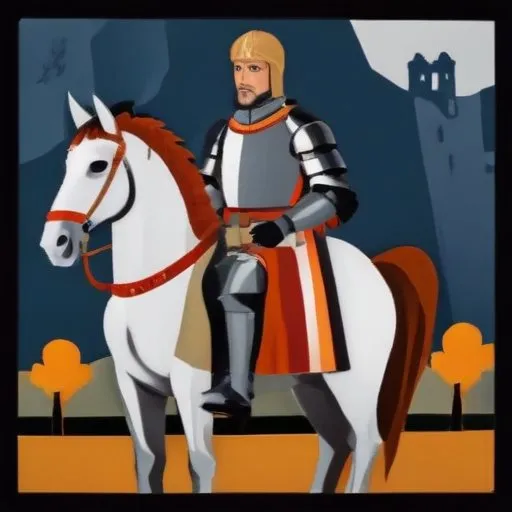
A German knight and landowner who led imperial troops during the Italian Wars and was a key figure in the development of modern warfare, known for his innovative tactics and military reforms.
Georg von Frundsberg, a renowned German military leader, is famously known as the "Father of the Landsknechte" for his groundbreaking infantry tactics and influential role in the Italian Wars. As a prominent figure in the service of the Holy Roman Empire and Imperial House of Habsburg, Frundsberg's military prowess and strength earned him great prestige and fame during his lifetime.
Born on September 24, 1473, in Mindelheim, Germany, Frundsberg was the youngest of nine sons to Ulrich von Frundsberg, a captain of the Swabian League forces, and his wife Barbara von Rechberg. With no chance of inheriting his father's dominion, Frundsberg was groomed for a warrior's career from infancy. He grew up at the castle in Mindelheim, which his father had purchased from his maternal uncle, Ber Bero II of Rechberg.
In 1492, Frundsberg followed his father in the campaign of the Hohenzollern margrave Frederick I of Brandenburg-Ansbach, authorized to execute the Imperial ban against Duke Albert IV of Bavaria. Although the expedition was cancelled, Frundsberg continued to hone his military skills, fighting for the Habsburg emperor Maximilian I against the Swiss Confederacy in the Swabian War of 1499. This experience led him to recognize the decline of heavy armored knights and the importance of infantry formations.
Frundsberg's innovative infantry tactics and achievements on the battlefield earned him legendary status, with stories of his incredible physical strength and paternal figurehead of the Landsknechte emerging during his lifetime. His military campaigns and strategies continue to influence modern warfare, cementing his place in history as a pioneer of infantry warfare.
In addition to his military accomplishments, Frundsberg's personal life was marked by significant milestones, including his marriage to Anna von Eberstein and the birth of his children. He also maintained close relationships with prominent figures of the time, including Emperor Charles V.
Georg von Frundsberg's life and military career spanned a tumultuous period in European history, marked by the Italian Wars, the rise of the Habsburg Empire, and the decline of the Holy Roman Empire. His legacy as a military leader and innovator continues to inspire and inform modern military strategies, solidifying his place as one of the most influential figures of the early modern period.
Georg von Frundsberg's remarkable life and achievements continue to captivate historians and military enthusiasts alike, solidifying his enduring legacy as a pioneering military leader and icon of the Renaissance era.
Born in 1459
First Holy Roman Emperor to rule simultaneously as King of the Romans and King of Spain, known for uniting fragmented German states and establishing the Habsburg dynasty.
Born in 1500
Ruling over a vast empire from 1519 to 1556, he was a powerful and influential leader who played a crucial role in shaping European politics and religion. He is most known for his efforts to unify Christian Europe and defend it against the Ottoman Empire.
Born in 1503
The first Habsburg to rule the Holy Roman Empire, he unified Austria and introduced the concept of a hereditary monarchy, shaping European politics for centuries to come.
Born in 1471
A Renaissance master of intricate woodcuts and engravings, known for precise and detailed depictions of nature and human form, influencing art and mathematics for centuries.
Born in 1494
A 16th-century master of Meistergesang, a traditional form of German poetry and song, who wrote over 6,000 works, including plays, poems, and songs, showcasing his wit and satire.
