


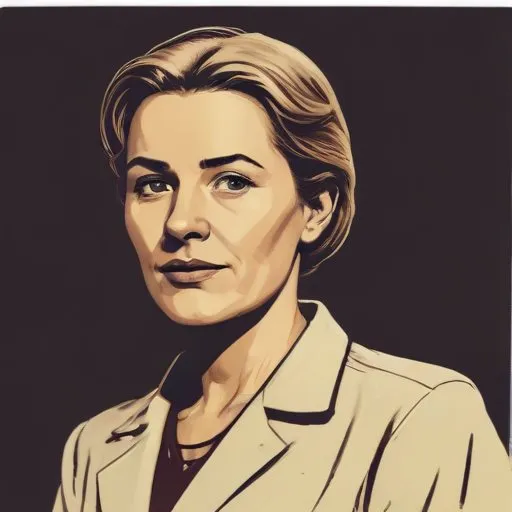
A pioneering female archaeologist and museum director who excavated and preserved ancient artifacts, significantly advancing our understanding of prehistoric cultures.
Gertrud Dorka was a trailblazing German archaeologist, prehistorian, museum director, and teacher who left an indelible mark on her field. She is renowned for being the first female director of the State Museum for Prehistory and Early History, a position she held from 1947 to 1958.
Born on March 19, 1893, in Orlau, Germany (now Orowo, Poland), Gertrud Dorka's early life was marked by her father's teaching profession. She followed in his footsteps, qualifying as a teacher in 1914. However, the outbreak of World War I forced her family to flee to Berlin, where she taught in various schools in Pankow.
Gertrud's thirst for knowledge led her to become a guest student at the University of Berlin, where she delved into anthropology, history, prehistory, and geology. Her fascination with archaeology was further fostered under the guidance of Albert Kiekebusch at the Märkisches Museum, where she participated in excavations.
Gertrud's academic pursuits continued at the University of Berlin and the University of Kiel between 1930 and 1936, where she studied anthropology, geography, and prehistory. Her doctoral thesis, focused on the town of Pyrzyce, was completed in 1936 under the supervision of Gustav Schwantes.
After completing her doctorate, Gertrud was offered a job at a museum in Kiel, conditional upon her joining the Nazi Party. Her strong moral compass led her to decline the offer, and she resumed her teaching career instead.
During World War II, Gertrud was evacuated to Zeitz with her school classes. Upon her return to Berlin in 1946, she resumed teaching, but her career took a dramatic turn when she became the museum director of the State Museum for Prehistory and Early History in 1947.
As museum director, Gertrud Dorka faced the daunting task of restoring the museum, which had been severely damaged during the war. She embarked on a mission to salvage artefacts from the rubble, even bribing locals to retrieve stolen items. Her perseverance paid off, and she successfully repatriated several museum properties that had been relocated to an estate in Lebus during the war.
Gertrud's leadership and expertise played a crucial role in rebuilding the museum and its collection. She worked tirelessly to promote the importance of prehistory and archaeology, inspiring a new generation of scholars and enthusiasts.
Gertrud Dorka's groundbreaking career was marked by her unwavering dedication to archaeology and her perseverance in the face of adversity. As a pioneering female archaeologist and museum director, she paved the way for future generations of women in the field.
Her contributions to the field of prehistory and archaeology continue to inspire and educate scholars and enthusiasts alike. Gertrud Dorka's legacy serves as a testament to the power of determination, hard work, and a passion for discovery.
Gertrud Dorka's remarkable life and career serve as a testament to her unwavering passion for archaeology and her commitment to promoting the importance of prehistory and cultural heritage.
Born in 1822
A pioneering archaeologist who uncovered the ancient city of Troy, verifying the historicity of Homer's epic poems. He's famous for his excavations that rewrote the history of the Mediterranean region.
Born in 1851
Uncovered the ruins of Knossos in Crete, revealing the Minoan civilization and its iconic bull-leaping frescoes. His excavations and interpretations shaped our understanding of ancient Mediterranean cultures.
Born in 1874
Discovered the tomb of Pharaoh Tutankhamun in Egypt, uncovering thousands of artifacts and treasures that revealed secrets of ancient Egyptian life.
Born in 1913
A pioneering archaeologist and anthropologist who uncovered crucial fossils and artifacts in Africa, shedding light on human evolution and ancient cultures.
Born in 1903
A pioneering palaeontologist and archaeologist who uncovered crucial evidence of human evolution in Africa, shedding light on the origins of humanity.
Born in 1906
Pioneering excavations in Jericho and Jerusalem uncovered ancient cities, rewriting biblical history. Her meticulous methods transformed archaeological practices.
Born in 1853
Pioneering excavations in Egypt uncovered ancient secrets, and innovative methods established modern archaeology standards.
