


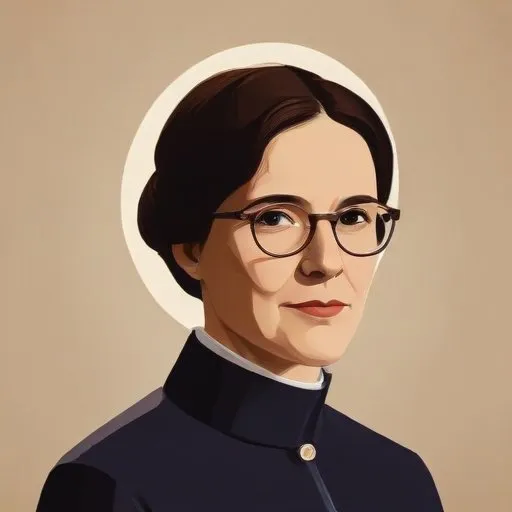
Pioneering statistician and educator who developed innovative methods for experimental design and analysis, making significant contributions to the field of statistics.
Gertrude Mary Cox was a trailblazing American statistician, known for her groundbreaking contributions to the field of experimental design and statistics. She was the first woman to establish a department of Experimental Statistics at North Carolina State University, and her work in the field earned her numerous accolades and honors.
Born on January 13, 1900, in Dayton, Iowa, Cox's journey began with a dream to become a deaconess in the Methodist Church. However, she soon shifted her focus to mathematics and statistics, earning her B.S. and Master's degrees from Iowa State College (now Iowa State University) in 1929 and 1931, respectively.
Cox's academic career took off when she was appointed assistant professor of statistics at Iowa State College in 1939. A year later, she became a professor of statistics at North Carolina State College (now North Carolina State University), where she established the department of Experimental Statistics, a first for a woman at the institution.
In 1950, Cox co-authored the book Experimental Designs with W. G. Cochran, which became the seminal reference work on experimental design for statisticians for decades to come. This publication cemented her reputation as a leading expert in the field.
Cox's achievements were recognized with numerous awards and honors. In 1949, she became the first woman elected into the International Statistical Institute. In 1956, she was elected President of the American Statistical Association, solidifying her position as a pioneer in the field of statistics.
Cox's work on experimental design has had a profound impact on various fields, including medicine, agriculture, and social sciences. Her contributions have enabled researchers to design experiments that yield more accurate results, leading to breakthroughs in areas such as disease treatment and crop improvement.
Gertrude Mary Cox's trailblazing achievements have paved the way for future generations of women in statistics. Her work continues to inspire and influence researchers, ensuring her legacy as a true pioneer in the field.
As a testament to her groundbreaking contributions, Cox's story serves as a beacon of inspiration, encouraging aspiring statisticians to pursue their dreams and push the boundaries of human knowledge.
Born in 1820
Pioneering nurse and statistician who revolutionized healthcare by introducing sanitation practices and data-driven decision making, becoming the founder of modern nursing.
Born in 1865
A British nurse who helped soldiers from both sides during WWI, and was executed by the Germans for treason, becoming a symbol of courage and compassion.
Born in 1821
Founded the American Red Cross, providing humanitarian aid and disaster relief, and pioneering nursing education. Known for her courageous and selfless efforts during the Civil War and beyond.
Born in 1867
Founded the Henry Street Settlement, a pioneering social service agency that provided healthcare, education, and community programs to immigrants and the working poor, and wrote extensively on social welfare and public health.
Born in 1802
Pioneering nurse and social reformer who crusaded for humane treatment of the mentally ill and prisoners, establishing asylums and advocating for their rights.
Born in 1909
An American anesthesiologist and pediatrician developed a crucial newborn health assessment tool, still widely used today to evaluate a baby's overall health and detect potential issues immediately after birth.
