


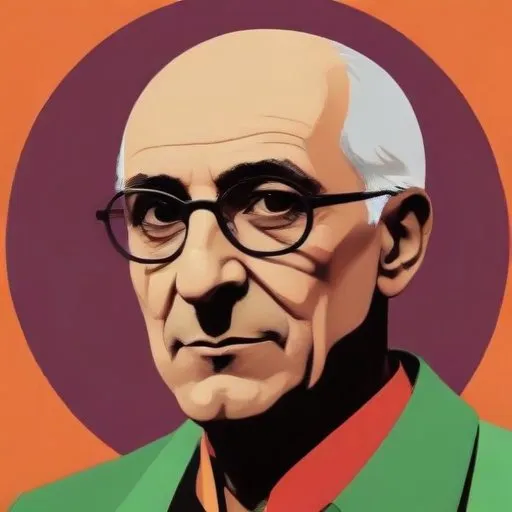
A renowned mathematician and philosopher who made significant contributions to combinatorics, probability theory, and phenomenology, and was a prolific writer on the philosophy of mathematics and science.
GianCarlo Rota was a renowned Italian-American mathematician and philosopher, best known for his groundbreaking contributions to combinatorics, functional analysis, probability theory, and phenomenology. His unique blend of mathematical rigor and philosophical insight earned him the distinction of being the only person to be appointed Professor of Applied Mathematics and Philosophy at the Massachusetts Institute of Technology (MIT).
Rota was born on April 27, 1932, in Vigevano, Italy, to a family of intellectuals. His father, Giovanni, was an architect and prominent antifascist, and his aunt, Rosetta, was a mathematician and wife of the writer Ennio Flaiano. Rota's family left Italy when he was 13 years old and initially settled in Switzerland before moving to Ecuador, where he attended the Colegio Americano de Quito.
Rota's academic pursuits took him to Princeton University, where he graduated with an A.B. in mathematics in 1953. His senior thesis, "On the solubility of linear equations in topological vector spaces," was completed under the supervision of William Feller. He then pursued graduate studies at Yale University, earning a Ph.D. in mathematics in 1956 with a dissertation on "Extension Theory Of Ordinary Linear Differential Operators" under the supervision of Jacob T. Schwartz.
Rota's career was marked by his appointments at MIT, where he spent most of his career. He was a professor of applied mathematics and philosophy, and later became the Norbert Wiener Professor of Applied Mathematics. His research and teachings spanned a wide range of topics, including combinatorics, functional analysis, probability theory, and phenomenology.
Rota was also a consultant at various prestigious institutions, including the Los Alamos National Laboratory, the Rand Corporation, and the Brookhaven National Laboratory. He held four honorary degrees from the University of Strasbourg, France, the University of LAquila, Italy, the University of Bologna, Italy, and Brooklyn Polytechnic University.
Rota's philosophical contributions were deeply rooted in his mathematical pursuits. He believed that mathematics was a fundamental aspect of human understanding, and that it held the key to unlocking the secrets of the universe. His philosophical writings explored the nature of reality, knowledge, and human existence.
Rota's philosophical approach was characterized by his emphasis on the importance of phenomenology, a philosophical movement that focuses on the study of conscious experience or perception. He believed that mathematics and philosophy were intertwined, and that a deep understanding of one required a deep understanding of the other.
Rota's work had a profound impact on modern society, particularly in the fields of mathematics, computer science, and philosophy. His contributions to combinatorics and functional analysis paved the way for significant advances in computer science and artificial intelligence.
His philosophical writings and teachings inspired a generation of scholars and thinkers, encouraging them to explore the interplay between mathematics and philosophy. Rota's legacy continues to influence modern thought, encouraging interdisciplinary approaches to problem-solving and critical thinking.
Rota's life was marked by several personal milestones, including his appointment as a professor at MIT, his election to the National Academy of Sciences, and his receipt of numerous honorary degrees. However, it was his unique blend of mathematical rigor and philosophical insight that truly defined his legacy.
Rota's life was also marked by his friendship with Stanislaw Ulam, a Polish-American mathematician and member of the Manhattan Project. Their friendship and collaborations had a profound impact on Rota's work and worldview.
GianCarlo Rota's legacy extends far beyond his impressive list of academic achievements. He inspired a generation of scholars and thinkers, encouraging them to explore the interplay between mathematics and philosophy. His work continues to influence modern thought, shaping our understanding of the world and our place within it.
Rota's unique approach to mathematics and philosophy serves as a testament to the power of interdisciplinary thinking. His legacy reminds us that even in the most complex and abstract of fields, there is beauty, elegance, and simplicity to be found.
Born in 1882
A pioneering mathematician and physicist who revolutionized abstract algebra and made groundbreaking contributions to modern physics, particularly in the development of Einstein's theory of general relativity.
Born in 1862
A renowned mathematician and academic who developed infinite-dimensional vector spaces and laid the foundation for quantum mechanics and relativity. He's also famous for his 23 unsolved math problems that shaped 20th-century mathematics.
Born in 1885
A pioneer in combining mathematics and physics, known for his work on quantum mechanics, relativity, and the philosophy of science. He introduced the concept of gauge theory, which is crucial in modern particle physics.
Born in 1903
Pioneering mathematician and physicist who developed the concept of the modern computer architecture and made significant contributions to quantum mechanics and game theory. His work laid the foundation for modern computing and artificial intelligence.
Born in 1906
A groundbreaking logician and philosopher who shook the foundations of mathematics with his incompleteness theorems, proving that no formal system can be both complete and consistent.
Born in 1901
Developed a rigorous definition of truth and laid the foundations for modern logic, making significant contributions to the fields of mathematics, philosophy, and linguistics.
Born in 1874
A philosopher who developed the concept of "symbolic forms" to understand human culture and knowledge, and is known for his work on the philosophy of science and the Enlightenment.
Born in 1872
A renowned thinker who made significant contributions to mathematics, philosophy, and social commentary, known for his influential writings on logic, ethics, and politics. He's a prominent figure in shaping modern intellectual thought.
