


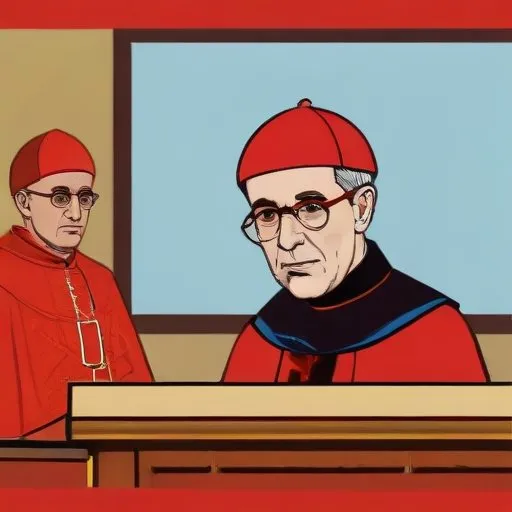
A 16th-century theologian and cardinal who played a key role in the Council of Trent, shaping Catholic Church reforms and counter-reformation efforts. He's known for his diplomatic skills and moderate stance.
Girolamo Seripando, an Augustinian friar, Italian theologian, and cardinal, left an indelible mark on the Catholic Church with his exceptional eloquence, zealous pursuit of biblical purity, and dedication to the Council of Trent. His remarkable life, spanning over seven decades, was a testament to his unwavering commitment to his faith and his role as a prominent figure in 16th-century Catholicism.
Born on May 6, 1493, in Troja, Apulia, Seripando hailed from a noble family. Despite being intended for the legal profession, he entered the Augustinian Order at the age of 14, following the death of his parents. He pursued his studies in Greek, Hebrew, philosophy, and theology at Viterbo, where his intellectual prowess began to take shape.
Seripando's remarkable oratory skills earned him a reputation as a gifted preacher. He lectured in Siena (1515) and later became a professor of theology in Bologna (1517). His exemplary service as vicar-general (1532) caught the attention of Emperor Charles V, who frequently attended his sermons. In 1539, Seripando was elected superior general, a position he held for 12 years, during which he demonstrated singular prudence, zeal, and piety.
In 1546, Seripando attended the Council of Trent, where he advocated for the purity of biblical texts and expressed views on original sin and justification that aligned with Lutheran perspectives. His theological acumen and eloquence impressed Pope Paul III, who appointed him as his legate to the Emperor and the King of France. Seripando declined the Bishopric of Aquila but later accepted the role of Archbishop of Salerno. His dedication to his faith and pastoral duties earned him recognition as a zealous and efficient pastor.
In 1561, Pope Pius IV elevated Seripando to the position of cardinal and second legate of the Holy See at the Council of Trent. Following the death of Cardinal Gonzaga, he became the first president of the council, a testament to his growing influence and respect within the Catholic Church.
Girolamo Seripando's life was a mosaic of intellectual pursuits, theological debates, and pastoral dedication. His commitment to the purity of biblical texts, his role in shaping Catholic doctrine, and his eloquent preaching made him a prominent figure in 16th-century Catholicism. As a cardinal, theologian, and pastor, Seripando left an indelible mark on the Catholic Church, inspiring generations of clergy and laity alike.
Seripando's writings and teachings continue to influence Catholic theology, serving as a testament to his enduring legacy as a theologian, cardinal, and guardian of the faith.
Born in 1504
Leader of the Catholic Church during the Counter-Reformation, he excommunicated Queen Elizabeth I and played a key role in the Council of Trent.
Born in 1504
Leader of the Catholic Church during the Counter-Reformation, he excommunicated Queen Elizabeth I and played a key role in the Council of Trent.
Born in 1538
A 16th-century Italian reformer who played a key role in the Counter-Reformation, implementing significant reforms within the Catholic Church, and was known for his piety and charitable works.
Born in 1542
A 16th-century theologian and doctor of the Church, known for his writings on spirituality and his role in shaping Catholic doctrine. He was a key figure in the Counter-Reformation, defending Catholicism against Protestantism.
Born in 1491
Founded the Jesuit Order, a Catholic religious organization known for its missionary and educational work, and developed the Spiritual Exercises, a guide for spiritual growth and discernment.
Born in 1502
Introduced the Gregorian calendar, a solar-based calendar that's widely used today, reforming the Julian calendar's inaccuracies.
Born in 1536
Led the Catholic Church during a tumultuous period, issuing papal bulls and playing a key role in the Counter-Reformation. He's also famous for his coffee habit, being the first Pope to try and approve of it.
