


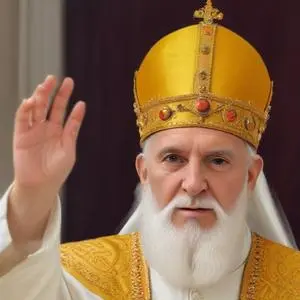
Established the Jesuit order, convened the Council of Trent, and played a significant role in the Counter-Reformation.
Pope Paul III, born Alessandro Farnese, was the head of the Catholic Church and ruler of the Papal States from 1534 to 1549, a period marked by uncertainty and upheaval in the Catholic Church. He is best known for initiating the Catholic Reformation with the Council of Trent in 1545, a pivotal moment in the Church's history that sought to address the challenges posed by the Protestant Reformation.
Alessandro Farnese was born on February 29, 1468, in Canino, Latium, to Pier Luigi I Farnese, Signore di Montalto, and his wife Giovanna Caetani. He received a humanist education at the University of Pisa and the court of Lorenzo de Medici, which laid the foundation for his future roles as a diplomat and church leader.
In 1491, Alessandro joined the Roman Curia, and in 1493, Pope Alexander VI appointed him Cardinal-Deacon of Santi Cosma e Damiano. His sister, Giulia, was reportedly a mistress of Alexander VI, and may have played a role in securing this appointment for her brother.
Pope Paul III was elected to the papacy in 1534, amidst the turmoil following the sack of Rome in 1527. During his pontificate, he faced numerous challenges, including the spread of Protestantism and the need to reform the Catholic Church. In response, he convened the Council of Trent, which lasted from 1545 to 1563 and resulted in significant reforms and clarifications of Catholic doctrine.
Pope Paul III was a renowned patron of the arts, commissioning works from prominent artists such as Michelangelo. He also recognized and supported new Catholic religious orders and societies, including the Jesuits, the Barnabites, and the Congregation of the Oratory.
Despite his many achievements, Pope Paul III's pontificate was also marked by nepotism and controversy. He worked tirelessly to advance the power and fortunes of his family, including his illegitimate son Pier Luigi Farnese, who would go on to become Duke of Parma and Piacenza.
Pope Paul III's legacy is complex and multifaceted. While he played a crucial role in shaping the Catholic Church's response to the Protestant Reformation, his nepotism and favoritism have been criticized by historians. Nevertheless, his initiatives and reforms helped to strengthen the Church and pave the way for the Counter-Reformation.
Pope Paul III was a visionary leader who navigated the treacherous waters of the Catholic Reformation with courage and determination. While his legacy is not without controversy, his contributions to the Catholic Church and Western culture remain significant and enduring.
Born in 1487
A 16th-century Pope who commissioned Michelangelo to paint the Sistine Chapel's frescoes and was a patron of the arts, leaving a lasting impact on Renaissance art and architecture.
Born in 1504
Leader of the Catholic Church during the Counter-Reformation, he excommunicated Queen Elizabeth I and played a key role in the Council of Trent.
Born in 1504
Leader of the Catholic Church during the Counter-Reformation, he excommunicated Queen Elizabeth I and played a key role in the Council of Trent.
Born in 1502
Introduced the Gregorian calendar, a solar-based calendar that's widely used today, reforming the Julian calendar's inaccuracies.
Born in 1414
Established the Vatican Archives and commissioned the Sistine Chapel's ceiling, which was famously painted by Michelangelo. He also played a significant role in the Renaissance.
Born in 1568
The 17th-century Catholic leader who reigned for 21 years, known for his strong stance against Galileo Galilei and his scientific discoveries, as well as his extensive patronage of the arts.
Born in 1519
The 151st Pope of the Catholic Church, serving for only two months in 1591, he is mostly remembered for his brief and uneventful papacy.
Born in 1536
Led the Catholic Church during a tumultuous period, issuing papal bulls and playing a key role in the Counter-Reformation. He's also famous for his coffee habit, being the first Pope to try and approve of it.
