


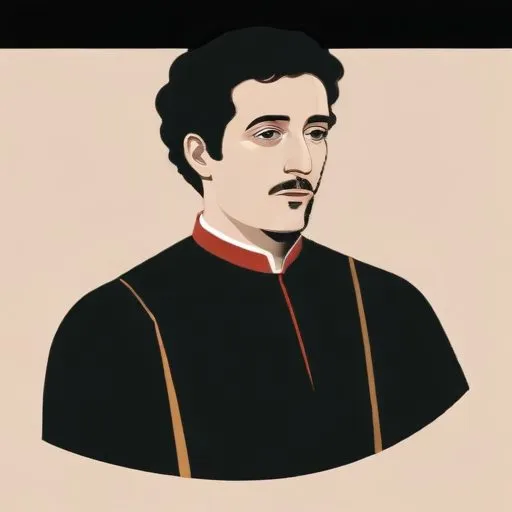
Illegitimate son of Italian noble, known for his involvement in a famous 1506 conspiracy against his brother Alfonso I d'Este, Duke of Ferrara. He was a key figure in the plot, which ultimately failed.
Giulio d'Este, the illegitimate son of Ercole I d'Este, Duke of Ferrara, is known for his tumultuous relationships with his half-brother, Ippolito d'Este, and the conspiracies that marred their lives. Born on July 13, 1478, Giulio's life was marked by power struggles, family rivalries, and a series of events that would shape the course of Ferrara's history.
Giulio was born to Isabella Arduin, a lady-in-waiting to Ercole's wife, Eleonora d'Aragon. He had six half-siblings from his father's marriage, including Alfonso I d'Este, Ippolito d'Este, Ferrante d'Este, Isabella d'Este, Beatrice d'Este, and Sigismondo d'Este. Growing up in the court of Ferrara, Giulio was exposed to the intricacies of power and politics from a young age.
The rivalry between Giulio and Ippolito began early, fueled by their differing personalities and ambitions. The first major conflict arose in 1504, when Ippolito abducted Don Rainaldo, a musician in Giulio's service, to perform in his chapel. Giulio, determined to assert his authority, recovered Rainaldo and replaced him with the warden of the fortress where he was being held.
This act of defiance sparked a chain of events, including the exile of Ferrante to Modena and Giulio to Brescello. The intervention of Lucrezia Borgia, wife of Alfonso, and Isabella d'Este eventually led to their pardon. However, the feud between the brothers continued, with their rivalry escalating into a full-blown conspiracy.
The turning point in their relationship came when both Giulio and Ippolito fell for Angela Borgia, a cousin of Lucrezia and a lady-in-waiting at the court of Ferrara. The Cardinal, known for his libertine ways, was furious when he discovered that Giulio was favored by Angela. This led to a series of plots and counter-plots, with both brothers attempting to outmaneuver each other.
Giulio's life was marked by periods of exile, imprisonment, and reconciliation, as the feud between the brothers ebbed and flowed. Despite the turmoil, Giulio managed to maintain a degree of autonomy, eventually residing in his palace on the Via degli Angeli road in Ferrara.
Giulio d'Este's life serves as a testament to the complexities of power and family dynamics in Renaissance Italy. His struggles with Ippolito d'Este reflect the tumultuous nature of the Este family and the Machiavellian politics of the time. While his legacy is often overshadowed by that of his more prominent half-brothers, Giulio's story offers a fascinating glimpse into the intrigue and drama of the Ferrara court.
Giulio d'Este died on March 24, 1561, leaving behind a legacy of power struggles, family feuds, and a testament to the enduring complexities of human relationships.
Through his tumultuous life, Giulio d'Este remains an enigmatic figure, a testament to the complexities of power, family, and politics in Renaissance Italy.
Born in 1480
The illegitimate child of a powerful pope, known for her ruthless politics, alleged poisonings, and scandalous marriages that shaped the Italian Renaissance.
Born in 1431
Ruthless and cunning, this Pope was infamous for his corrupt and immoral ways, using his power to further his family's interests.
Born in 1475
A ruthless and cunning politician who rose to power in the Renaissance era through intrigue and military conquest, leaving a lasting legacy in politics and governance.
Born in 1466
An Italian nobleman and first husband of Lucrezia Borgia, known for his marriage and subsequent annulment that sparked a scandal in the powerful Borgia family. He played a significant role in Renaissance politics and intrigue.
Born in 1487
A 16th-century Pope who commissioned Michelangelo to paint the Sistine Chapel's frescoes and was a patron of the arts, leaving a lasting impact on Renaissance art and architecture.
Born in 1479
A powerful and wealthy Renaissance cardinal who amassed a vast collection of art and antiquities, and was a patron of the arts.
