


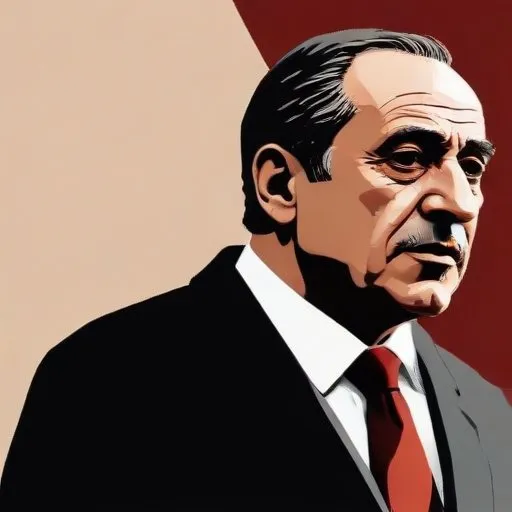
The 5th President of Italy, a lawyer and politician, served from 1964 to 1971, playing a key role in shaping the country's post-war politics and economy. He's remembered for his efforts to modernize Italy and strengthen its international relations.
Giuseppe Saragat, one of Italy's most influential politicians, served as the President of Italy from 1964 to 1971, earning him a place in the country's history books as a champion of democratic socialism. During his tenure, he skillfully navigated the complex web of Italian politics, fostering unity and cooperation among the country's diverse factions.
Born on September 19, 1898, in Turin, Piedmont, Kingdom of Italy, to Sardinian parents, Saragat's fascination with politics began at a young age. He joined the Unitary Socialist Party (PSU) in 1922, marking the start of his lifelong commitment to democratic socialism.
In 1926, Saragat fled to Vienna, and later to France in 1929, to escape the fascist regime's persecution. During his time in exile, he continued to advocate for social justice and democracy, undeterred by the challenges he faced.
In 1947, Saragat's concerns over the Italian Socialist Party's (PSI) close ties with the Italian Communist Party led him to establish the Socialist Party of Italian Workers (PSLI), which later became the Italian Democratic Socialist Party (PSDI). As the party's paramount leader, Saragat championed reformist policies, earning him a reputation as a beacon of moderation in Italian politics.
Saragat's remarkable career spanned various roles, including minister without portfolio, ambassador to Paris, and president of the Constituent Assembly of Italy. His appointment as President of the Italian Republic in 1964 marked a rare instance of unity among the country's left-wing parties, and he played a crucial role in stabilizing the country's government.
Saragat's personal life was marked by contrasts. An avowed atheist, he surprisingly converted to Catholicism later in life and received a religious funeral upon his passing on June 11, 1988, in Rome.
Giuseppe Saragat's commitment to democratic socialism, his unwavering dedication to Italian politics, and his ability to unify disparate factions have left an indelible mark on Italy's history. His legacy serves as a testament to the power of perseverance and compromise in the pursuit of a better future for all.
Born in 1877
First President of the Italian Republic, instrumental in shaping the country's post-WWII government and constitution. Known for his key role in Italy's transition to a republic.
Born in 1874
An Italian economist and politician who served as the 2nd President of the Italian Republic, known for his economic reforms and role in shaping post-WWII Italy. He's a key figure in Italian history and politics.
Born in 1887
An Italian war hero and statesman who served as President of the Italian Republic from 1955 to 1962, known for his efforts to rebuild and stabilize post-war Italy.
98 Years Old
An Italian academic and politician who served as the 8th President of Italy, known for his role in shaping the country's politics and foreign policy during the Cold War era. He was a key figure in Italy's transition from a monarchy to a republic.
Born in 1918
The 9th President of Italy, a lawyer and politician who played a key role in shaping the country's post-war politics and served as a senator for life. He's remembered for his strong stance against organized crime and corruption.
Born in 1925
A prominent Italian journalist and politician who served as Prime Minister of Italy, known for his leadership during a tumultuous period in the country's history. He played a key role in shaping Italy's post-war politics and economy.
Born in 1908
Italian journalist and politician who served as Prime Minister of Italy six times, playing a key role in shaping the country's post-war politics and economy. He was a dominant figure in Italian politics for over three decades.
