


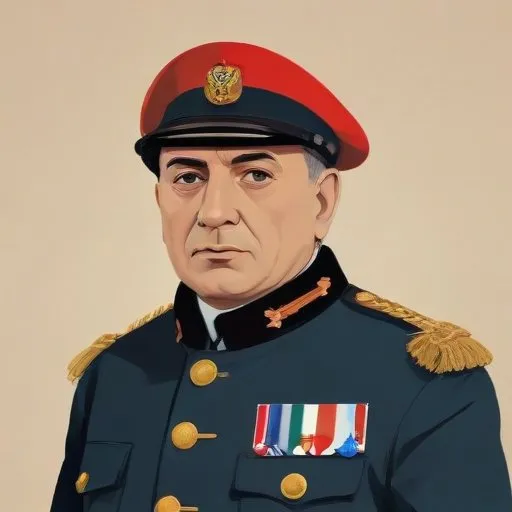
An Italian war hero and statesman who served as President of the Italian Republic from 1955 to 1962, known for his efforts to rebuild and stabilize post-war Italy.
Giovanni Gronchi, born on September 10, 1887, in Pontedera, Tuscany, Italy, is best known for his tumultuous presidency of Italy from 1955 to 1962, marked by a failed attempt to bring about an opening to the left in Italian politics. During his presidency, he was reputed to be the real holder of executive power, wielding significant influence behind the scenes of various prime ministers.
Gronchi's early political career began as an early member of the Christian Movement founded by Catholic priest Don Romolo Murri in 1902. He obtained a degree in literature and philosophy from the Scuola Normale Superiore di Pisa and worked as a high school teacher of classics in several Italian towns before volunteering for military service in World War I.
After the war, Gronchi became one of the founding members of the Catholic Italian Popular Party in 1919. He was elected to represent Pisa in both the parliamentary elections of 1919 and 1921. His involvement in the trade union movement led him to become a leader in the Italian Confederation of Christian Workers.
In 1922-1923, Gronchi served in the first government of Benito Mussolini as Undersecretary for Industry and Commerce. However, in April 1923, the national meeting of the Popular Party held in Turin decided to withdraw all PPI representatives from the government, and Gronchi returned to his role in the leadership of the Catholic trade unions. He faced daily violence brought against them by fascist squads, and later became the leader of the PPI, along with two other triumvirs, after Luigi Sturzo's resignation as Secretary of the PPI in 1924.
Gronchi joined the antifascist opposition of the so-called Aventine Secession, withdrawing from Parliament in protest of Mussolini's regime. During World War II, he continued to oppose fascism, and after the war, he played a key role in rebuilding Italy's political landscape.
Gronchi's presidency was marked by controversy, particularly in his attempts to bring about an opening to the left in Italian politics. His close relationships with socialist leaders and his efforts to reform the Italian political system were met with resistance from conservative forces, leading to a tumultuous presidency.
Gronchi's presidency may have been marked by controversy, but his commitment to democratic values and his opposition to fascism have secured his place in Italian history. His presidency serves as a significant chapter in Italy's transition from fascism to democracy, and his legacy continues to shape Italian politics to this day.
Gronchi's presidency and his commitment to democratic values have had a lasting impact on Italian society. His attempts to bring about an opening to the left in Italian politics paved the way for future political reforms and continue to influence Italian politics today.
"The Christian Democratic movement is not a party, it is a movement of the spirit." - Giovanni Gronchi
Gronchi's presidency is often compared to that of other European leaders of the time, including France's Charles de Gaulle and Germany's Konrad Adenauer. While Gronchi's presidency was marked by controversy, his commitment to democratic values and his opposition to fascism set him apart from his contemporaries.
Gronchi's presidency serves as a significant chapter in Italy's transition from fascism to democracy. His legacy continues to shape Italian politics to this day, and his commitment to democratic values remains an important part of Italy's political heritage.
Born in 1881
Italian journalist and politician who served as the 30th Prime Minister of Italy, leading the country's post-WWII reconstruction and European integration efforts. He's known for his key role in shaping modern Italy's politics and economy.
Born in 1908
Italian journalist and politician who served as Prime Minister of Italy six times, playing a key role in shaping the country's post-war politics and economy. He was a dominant figure in Italian politics for over three decades.
Born in 1916
The 39th Prime Minister of Italy, a prominent figure in post-war Italian politics, known for his efforts to establish a historic compromise between Christian Democrats and Communists. He was kidnapped and murdered by the Red Brigades in 1978.
Born in 1922
Leader of the Italian Communist Party who implemented a policy of Eurocommunism, seeking to reform the party and distance it from Soviet influence.
Born in 1893
An Italian politician who played a crucial role in shaping the country's post-WWII government and was a key figure in the Italian Communist Party, known for his efforts to reform the justice system.
Born in 1919
A dominant figure in Italian politics, serving as Prime Minister seven times, known for his cunning and controversial leadership style. He was a key player in shaping Italy's post-war politics.
97 Years Old
An Italian academic and politician who served as the 8th President of Italy, known for his role in shaping the country's politics and foreign policy during the Cold War era. He was a key figure in Italy's transition from a monarchy to a republic.
Born in 1918
The 9th President of Italy, a lawyer and politician who played a key role in shaping the country's post-war politics and served as a senator for life. He's remembered for his strong stance against organized crime and corruption.
