


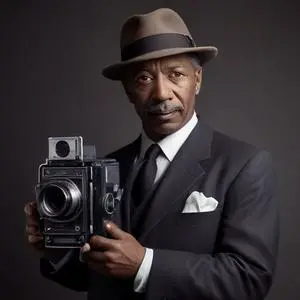
A pioneering African American photographer and filmmaker who captured the lives of marginalized communities, exposing social injustices through powerful, poignant images.
Gordon Parks, a trailblazing American photographer, composer, author, poet, and film director, left an indelible mark on the world of arts and social justice. Through his lens, he captured the beauty and complexity of the human experience, shedding light on the struggles of African Americans, poverty, and civil rights in the 1940s and 1970s.
Parks' extraordinary career spanned multiple genres, from documentary photojournalism to filmmaking, and from poetry to music composition. His groundbreaking work not only reflected the realities of his time but also inspired generations to come.
Parks' photographic essays, particularly those he created for Life magazine, exposed the harsh realities of poverty, segregation, and racial injustice in America. His iconic images, such as "American Gothic" (1942) and "Flavio da Silva Ramos" (1943), humanized the struggles of marginalized communities and provoked national conversations about social inequality.
As one of the first black American filmmakers to direct films within the Hollywood system, Parks blazed a trail for future generations. His semi-autobiographical film, The Learning Tree (1969), was the first feature film by a black director to be financed by a major Hollywood studio. He went on to direct Shaft (1971) and Shaft's Big Score (1972), helping create the blaxploitation genre.
Gordon Parks was born on November 30, 1912, in Fort Scott, Kansas, to Andrew Jackson Parks and Sarah Ross. As the youngest of 15 children, he grew up in a poor but resourceful family that instilled in him a strong sense of resilience and determination.
Gordon Parks' contributions to the world of arts and social justice are immeasurable. He inspired a generation of artists, filmmakers, and activists to use their creative voices to bring about change. His work continues to educate, inspire, and provoke, ensuring his legacy as a beacon of hope and humanity.
Gordon Parks' remarkable life and work serve as a testament to the power of creativity, perseverance, and the human spirit. As a visionary chronicler of the human experience, he continues to inspire us to see, to feel, and to act for a better world.
Born in 1902
A renowned poet, novelist, and playwright who powerfully voiced the experiences and struggles of African Americans during the Harlem Renaissance, using jazz and blues rhythms to convey the spirit of his people.
89 Years Old
Award-winning author of novels and non-fiction books, exploring themes of Canadian identity, history, and social issues. Known for his thought-provoking and engaging storytelling style.
Born in 1914
A pioneering African American writer who explored the complexities of race and identity through his novels, particularly the classic "Invisible Man".
Born in 1895
Documented the lives of those affected by the Great Depression and the Dust Bowl through powerful, poignant photographs that humanized the struggles of the era. Captured iconic images that shaped the national conversation around poverty and social justice.
Born in 1924
A renowned African American writer and civil rights activist, known for exploring the experiences of black Americans through novels, essays, and poetry that probe issues of race, identity, and social justice.
Born in 1891
A celebrated author and anthropologist who explored African-American culture through novels, stories, and folklore, particularly in the rural South during the early 20th century.
Born in 1925
A prominent figure in the Civil Rights Movement, advocating for African American rights and self-defense, and a powerful orator who inspired a generation.
