


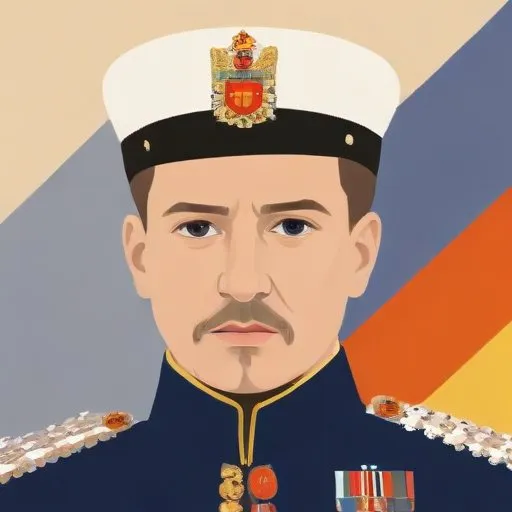
A Russian grand duke who served as the Governor-General of Caucasia and implemented reforms in the region, known for his military and administrative career.
Grand Duke Michael Nikolaevich of Russia was the fourth son and seventh child of Emperor Nicholas I of Russia and Charlotte of Prussia, but he made a name for himself as the Governor General of Caucasia for 20 years, from 1862 to 1882. During this period, he served as the nominal Commander-in-Chief of the Russian troops in the Caucasus and was appointed Field Marshal General in April 1878, leaving an indelible mark on the region.
Born on October 25, 1832, Grand Duke Michael Nikolaevich was part of a royal family that would see four members rule as Emperors of Russia, including his father, brother, nephew, and grandnephew. He married Princess Cecilie of Baden in 1857, and she adopted the name Olga Feodorovna, with whom he had seven children.
Grand Duke Michael Nikolaevich's 20-year tenure as Governor General of Caucasia was marked by his commitment to the region's development. He was stationed in Tbilisi, a city that would become a second home to his children. During the Russo-Turkish War of 1877-1878, he played a crucial role as the nominal Commander-in-Chief of the Russian troops in the Caucasus.
Grand Duchess Maria Pavlovna, granddaughter of his eldest brother, remembered Grand Duke Michael Nikolaevich as an "old gentleman of great height and unforgettable elegance." He was known for his affability, perfection of gestures, and air of a grand seigneur of a bygone era. Even in his later years, he maintained a charming aura, bowing with touching grace before women as he kissed their hands.
Grand Duke Michael Nikolaevich of Russia left behind a legacy of service, elegance, and affability. As the last surviving legitimate grandchild of Paul I of Russia, he remained an important figure in the Romanov dynasty. His influence on modern society lies in his commitment to public service and his role in shaping the course of Russian history.
Today, Grand Duke Michael Nikolaevich is remembered as a symbol of a bygone era, one of grandeur and elegance, but also of duty and service. His life serves as a testament to the enduring power of hard work, dedication, and refinement.
Born in 1868
The last emperor of Russia, ruling from 1894 to 1917, known for his poor leadership and decisions that led to the downfall of the Romanov dynasty and the rise of communism.
Born in 1845
The Russian monarch who ruled from 1881 to 1894, known for his conservative and nationalistic policies, as well as his efforts to reform the Russian Empire's government and economy.
Born in 1845
The Russian monarch who ruled from 1881 to 1894, known for his conservative and nationalistic policies, as well as his efforts to reform the Russian Empire's government and economy.
Born in 1868
The last emperor of Russia, ruling from 1894 to 1917, known for his poor leadership and decisions that led to the downfall of the Romanov dynasty and the rise of communism.
Born in 1729
Empress of Russia from 1762 to 1796, she transformed her country into a major European power, modernizing its culture, politics, and economy through numerous reforms and conquests.
Born in 1672
Reformed Russia's government, military, and culture, transforming it into a major European power. Known for modernizing and westernizing the country through numerous reforms and founding St. Petersburg.
Born in 1818
Liberalizing reforms and abolishing serfdom in Russia, earning the nickname "Liberator."
