


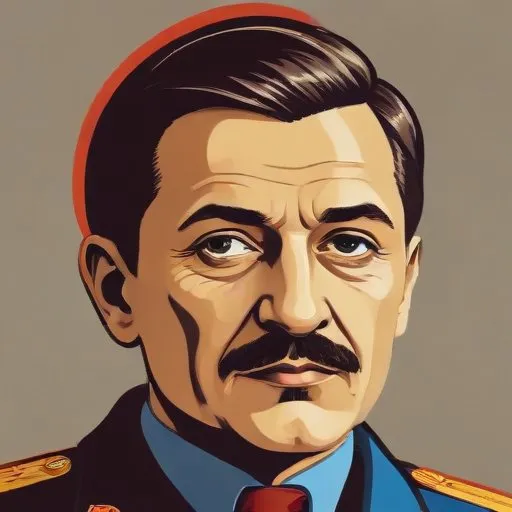
A Ukrainian Soviet revolutionary and politician who played a key role in the Russian Revolution and later became the Chairman of the Ukrainian Soviet Socialist Republic, known for his efforts to establish Soviet power in Ukraine.
Grigory Petrovsky is best known for his instrumental role in shaping the Soviet Union, particularly in Ukraine, as a prominent politician and Old Bolshevik. He played a crucial part in signing the Treaty on the Creation of the Union of Soviet Socialist Republics and the Treaty of Brest-Litovsk, solidifying his position as a key figure in Soviet history.
Born on February 4, 1878, in the village of Pechenihy, Kharkov Governorate, Petrovsky's early life was marked by hardship. His father, a craftsman, passed away when Petrovsky was just three years old. Despite these challenges, he went on to attend the Kharkiv Theological Seminary, but was eventually dismissed in 1889 due to financial difficulties.
At the tender age of 11, Petrovsky began working at a locomotive depot to support his family. This experience sparked his interest in revolutionary movements, and by 1895, he had joined the Russian Social Democratic Labour Party (RSDRP). He quickly became an active participant in the fight for workers' liberation, contributing to the Bolsheviks' cause in various regions, including Mykolaiv to Mariupol, and the Donets Basin to Kharkiv.
In 1905, Petrovsky emerged as a leader during the Russian Revolution, organizing and leading the Yekaterinoslav City Council of Workers Deputies and the local Battle Strike Committee. Although he was forced to flee to Germany for a brief period, he returned to Ukraine and continued to play a significant role in the country's politics. However, his implementation of Stalin's policy of collectivization has been criticized for its harsh consequences on the Ukrainian people.
As a Communist Party leader in Ukraine until 1938, Petrovsky left an indelible mark on the country's history. His involvement in the signing of significant treaties and his contributions to the Soviet Union's development have cemented his place as a key figure in Soviet politics. Although controversies surrounding his policies exist, Petrovsky's dedication to the Bolshevik cause and his unwavering commitment to the Soviet Union are undeniable.
Grigory Petrovsky's life and career are inextricably linked to the tumultuous era of Soviet politics. His rise to prominence during the Russian Revolution and his subsequent role in shaping Ukraine's politics have left a lasting impact on the region. As a testament to his legacy, Petrovsky's name is etched in history as a devoted Bolshevik and a key figure in the Soviet Union's development.
Born in 1870
Founder of the world's first socialist state, leading the Bolshevik Revolution and establishing the Soviet Union, known for his radical Marxist ideology and authoritarian rule.
Born in 1878
The Soviet Union's ruthless leader who ruled with an iron fist, implementing policies that led to widespread famine and purges, while also playing a crucial role in defeating Nazi Germany in World War II.
Born in 1879
Founded the Red Army and played a crucial role in the Russian Revolution, shaping the course of modern communism. A key figure in 20th-century politics and ideology.
Born in 1875
The first Head of State of the Soviet Union, serving from 1919 to 1946, known for his role in establishing the Soviet government and implementing Stalin's policies. He was a key figure in the Soviet leadership during World War II.
Born in 1888
A prominent figure in the Russian Revolution, he was a key architect of the Soviet economy and a vocal critic of Stalin's regime, ultimately falling victim to his purges.
Born in 1877
Founder of the Soviet secret police, known for his role in establishing the Cheka, a precursor to the KGB, and implementing repressive policies during the Russian Revolution.
Born in 1899
Soviet Union's ruthless secret police chief, responsible for millions of deaths and brutal suppressions during Stalin's regime, known for his cunning and feared reputation.
Born in 1894
The Soviet leader who initiated reforms and denounced Stalin's regime, known for his bold policies and iconic shoe-banging incident at the UN.
