


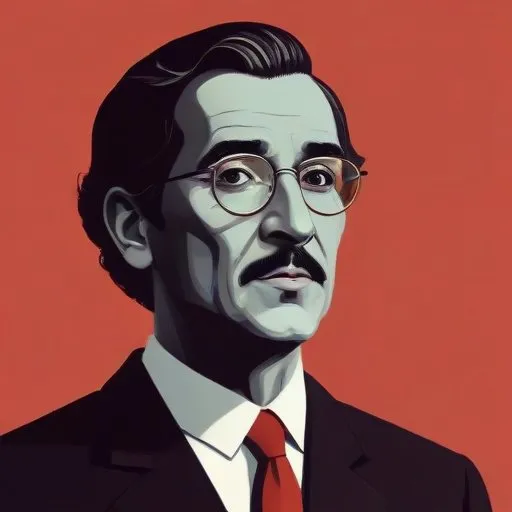
A Portuguese journalist, lawyer, and politician who fought for the abolition of the monarchy and establishment of the First Portuguese Republic, known for his influential writings and oratory skills.
Guerra Junqueiro, a Portuguese top civil servant, journalist, author, and poet, is best known for his satirical works that criticized conservatism, romanticism, and the Church, paving the way for the creation of Portugal's First Republic. His poetry was instrumental in shaping public opinion, contributing to the discredit of the Portuguese monarchy and the success of the Republican Party in the 1910 revolution.
Born on September 17, 1850, in Freixo de Espada à Cinta, Portugal, Guerra Junqueiro was the son of a supply trader and farmer, José Antônio Junqueiro Júnior, and his wife, Ana Maria Guerra. After his mother's untimely death when he was just three years old, he went on to study law at the University of Coimbra, where he graduated in 1873.
Guerra Junqueiro's early career saw him working as a secretary to the governor of Angra do Heroísmo, Azores, and later, Viana do Castelo. In 1878, he was elected to the House of Representatives, marking the beginning of his foray into politics.
In 1885, Guerra Junqueiro published "A Velhice do Padre Eterno" (The Old Age of Father Eternal), a work that generated strong criticism from the Portuguese Catholic Church. This was followed by a series of bestsellers that had a significant impact on public opinion, ultimately contributing to the downfall of the monarchy and the rise of the Republican Party.
Guerra Junqueiro married Filomena Augusta da Silva Neves in 1880, and the couple had two children, Maria Isabel and Júlia. He translated several short stories by Hans Christian Andersen into Portuguese, showcasing his love for literature and language.
Guerra Junqueiro's poetry and writings played a significant role in shaping public opinion and influencing the political landscape of Portugal. His satirical works critiqued the establishment, paving the way for a new era of republicanism and democracy.
In 1940, Guerra Junqueiro's daughter donated his estate to the nation, ensuring that his literary and historical legacy would be preserved for generations to come. Today, he is remembered as one of Europe's greatest poets, whose contributions to literature and politics continue to inspire and influence Portuguese society.
Guerra Junqueiro's poetry is filled with wit and satire, offering insightful commentary on the human condition. One of his most famous quotes is:
"O país é uma nação de padres, e os padres são uma raça de homens que não sabem o que é uma pátria"(The country is a nation of priests, and the priests are a breed of men who do not know what a homeland is.)
This quote, like much of his work, critiques the clergy and highlights the need for a more secular and democratic society.
Born in 1830
A 19th-century poet and educator who played a crucial role in shaping Portuguese literature and education, introducing Romanticism and realism to the country's literary scene.
Born in 1825
A 19th-century novelist who penned over 260 works, primarily romances and historical novels, offering vivid portrayals of Portuguese life and society. His writings are considered a cornerstone of Portuguese literature.
