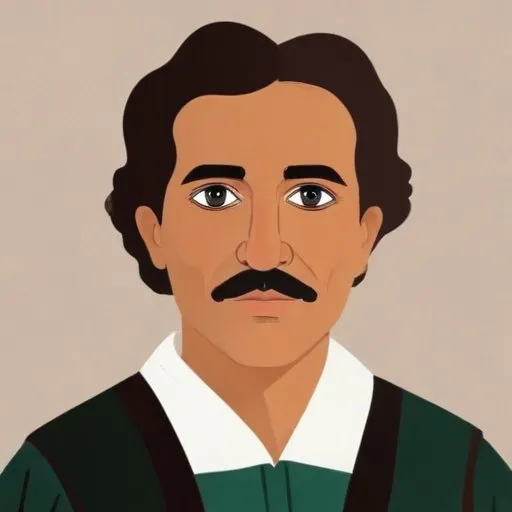
Joo de Deus: The Portuguese Poet and Pedagogue Who Revolutionized Education
The Father of Modern Portuguese Education
Joo de Deus, born Joo de Deus de Nogueira Ramos, is renowned for his groundbreaking didactic book,
Cartilha Maternal, published in 1876. This iconic textbook played a pivotal role in shaping the Portuguese education system, being used to teach the Portuguese language across the country for over a century.
Early Life and Education
Born on March 8, 1830, in So Bartolomeu de Messines, Silves, in the Algarve region of Portugal, Joo de Deus was the son of Pedro Jos Ramos and Isabel Gertrudes Martins. He matriculated in the faculty of law at the University of Coimbra, although he never pursued his degree. Instead, he dedicated himself to composing verses, which circulated among professors and undergraduates in manuscript copies.
Literary Career
Joo de Deus' writing career was marked by a rigorous self-control. He printed nothing before 1855, and his first published poem,
A Lata, appeared in 1860. His poetry collections,
Flores do Campo (1868) and
Ramo de Flores (1869), showcased his mastery of Portuguese literature.
Pedagogical Contributions
Joo de Deus' most significant contribution to Portuguese education was his
Cartilha Maternal. This textbook introduced a revolutionary approach to teaching, emphasizing the importance of phonetic learning and providing a comprehensive framework for language education. Its impact was profound, shaping the education system in Portugal for generations to come.
Public Life and Politics
In 1868, Joo de Deus was elected as a deputy for the constituency of Silves. However, he refused to seek renewal of his mandate in 1869, choosing instead to maintain his independence from political parties. This decision reflected his strong character and commitment to his principles.
Legacy
Joo de Deus' contributions to Portuguese literature and education have endured for centuries. His poetry continues to be celebrated for its beauty and nuance, while his pedagogical innovations have had a lasting impact on the country's education system. Today, he is remembered as a titan of Portuguese culture, leaving behind a rich legacy that continues to inspire and educate.
Major Works
- A Lata (1860)
- Flores do Campo (1868)
- Ramo de Flores (1869)
- Cartilha Maternal (1876)
Personal Milestones
- Born on March 8, 1830, in So Bartolomeu de Messines, Silves, Algarve, Portugal
- Elected as a deputy for the constituency of Silves in 1868
- Refused to seek renewal of his mandate in 1869
- Published Cartilha Maternal in 1876
- Died on January 11, 1896
FAQ
What was João de Deuss contribution to Portuguese literature?
João de Deus, a Portuguese poet and educator, made significant contributions to Portuguese literature, particularly in the development of modernist poetry. His work showcased his mastery of language and his ability to craft innovative and expressive verse.
How did João de Deuss poetry impact Portuguese cultural identity?
João de Deuss poetry had a profound impact on Portuguese cultural identity, as it explored themes of national identity, history, and culture. His work helped to shape a sense of Portuguese identity and facilitated a deeper understanding of the countrys cultural heritage.
What was João de Deuss role in the development of Portuguese education?
João de Deus played a crucial role in the development of Portuguese education, as he was a pioneering educator who introduced new teaching methods and curricula. His work helped to modernize the Portuguese education system and facilitated greater access to education for all.
How did João de Deuss work impact the Portuguese language?
João de Deuss work had a significant impact on the Portuguese language, as he was a champion of linguistic reform and modernization. His work helped to standardize the Portuguese language and facilitated greater clarity and precision in communication.
What was João de Deuss legacy in Portuguese letters?
João de Deuss legacy in Portuguese letters is that of a visionary poet and educator who helped to shape the course of Portuguese literature and culture. His work continues to inspire future generations of writers, educators, and scholars, cementing his place as a towering figure in Portuguese cultural history.