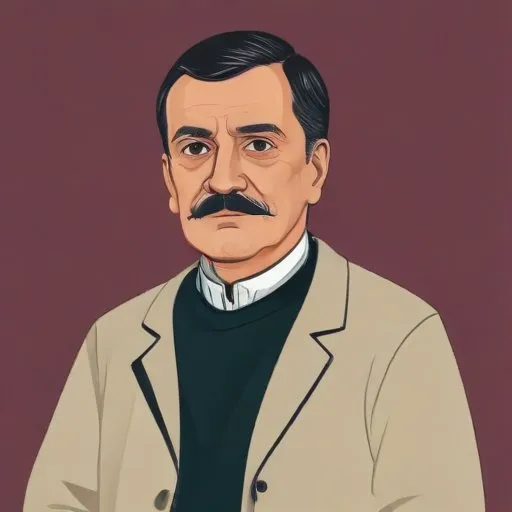
Guillermo Haro

Guillermo Haro

Guillermo Haro was born on March 21st, 1913

Full Name: Guillermo Haro
Place of Birth: Mexico City, Mexico
Profession: Astronomer
Field: Stellar astronomy
Nationality: Mexican
Works At: Tonantzintla Observatory
Active Since: 1940s
Awards: National Prize for Science

Discovered several astronomical objects, including flare stars and nebulae, and made significant contributions to the field of astrophysics.

Written by: Thomas Blackwood Thomas Blackwood

Guillermo Haro: The Doyen of Mexican Astronomy

Guillermo Haro, a Mexican astronomer, etched his name in the annals of astronomy history with his groundbreaking discovery of Herbig-Haro objects, a type of celestial entity that shed light on the mysteries of star formation. His pioneering work in observational astronomy not only transformed the Mexican astronomy landscape but also earned him international recognition.

Early Life and the Spark of Astronomy

Born on March 21, 1913, in Mexico City, Haro's early life was marked by an avid interest in philosophy and law, which led him to study at the National Autonomous University of Mexico (UNAM). However, a fateful interview with Luis Enrique Erro in 1937 ignited a passion for astronomy that would become a lifelong pursuit.

The Formative Years

A Stellar Career

Upon his return to Mexico in 1945, Haro continued to make significant contributions to astronomy, focusing on the study of extremely red and extremely blue stars.

Herbig-Haro Objects and Beyond

Haro's most notable achievements include the detection of:

These findings not only solidified Haro's reputation as a pioneering astronomer but also paved the way for subsequent generations of researchers.

Legacy and Impact

Guillermo Haro's contributions to astronomy have left an indelible mark on the scientific community.

Today, Haro's legacy continues to inspire and motivate scientists, ensuring that his groundbreaking discoveries remain an integral part of astronomy's rich tapestry.

A Lasting Tribute

Guillermo Haro's extraordinary life and work serve as a testament to the power of dedication, passion, and innovation. As we look up at the starry night sky, we are reminded of the profound impact this Mexican astronomer had on our understanding of the universe.

Timeline
1913
Born in Mexico City
Guillermo Haro was born on March 21, 1913, in Mexico City, Mexico. He would go on to become a prominent astronomer.
1937
Started Working at Tonantzintla Observatory
Haro began working at the Tonantzintla Observatory in Mexico, where he would make important discoveries about star formation and galaxy evolution.
1943
Discovered the First Planetary Nebula
Haro discovered the first planetary nebula, a type of celestial object formed by the death of a star.
1951
Founded the National Astronomical Observatory
Haro founded the National Astronomical Observatory in Mexico, which would become a leading center for astronomical research in the region.
1988
Died at Age 75
Guillermo Haro died on April 25, 1988, at the age of 75, leaving behind a legacy as one of Mexicos most important astronomers.
Guillermo Haro

Guillermo Haro Quiz

What type of celestial objects did Guillermo Haro discover?

Score: 0/5
FAQ
What were Guillermo Haros most significant contributions to astronomy?
Guillermo Haro was a Mexican astronomer who made significant contributions to our understanding of star formation and galactic evolution. He discovered several star clusters and nebulae, and his work laid the foundation for modern astrophysics.
How did Guillermo Haros work impact our understanding of star formation?
Guillermo Haros work on star formation and galactic evolution revolutionized our understanding of the universe. He discovered that stars are formed in giant molecular clouds, and his research paved the way for further studies on star birth and death.
What was Guillermo Haros role in the development of astronomy in Mexico?
Guillermo Haro played a crucial role in the development of astronomy in Mexico. He founded the Tonantzintla Observatory and was a prominent figure in the countrys astronomical community, inspiring future generations of Mexican astronomers.
How did Guillermo Haros research on Herbig-Haro objects contribute to our understanding of star formation?
Guillermo Haros research on Herbig-Haro objects, which are bright emission nebulae associated with young stars, provided valuable insights into the early stages of star formation. His work helped scientists understand the complex processes that govern star birth and development.
What is Guillermo Haros legacy in the astronomical community?
Guillermo Haros legacy in the astronomical community is that of a pioneering astronomer who made significant contributions to our understanding of the universe. He is remembered for his groundbreaking research, his mentorship of young astronomers, and his tireless advocacy for astronomy in Mexico.

Related People:

Subrahmanyan Chandrasekhar

Born in 1910

A renowned scientist who pioneered our understanding of black holes and the behavior of stars, earning a Nobel Prize in Physics in 1983.

Arthur Eddington

Born in 1882

A pioneer in astrophysics, he formulated the Eddington limit, a crucial concept in understanding stars, and was a key figure in popularizing Einstein's theory of relativity. His work bridged the gap between theory and observation in astronomy.

Harlow Shapley

Born in 1885

Measured the galaxy's size and mapped the Milky Way's structure, revolutionizing our understanding of the universe.

Edwin Hubble

Born in 1889

Discovered galaxies beyond our own Milky Way, revolutionizing our understanding of the universe's scale and expansion. Pioneered observational cosmology, providing evidence for the Big Bang theory.

Cecilia Payne-Gaposchkin

Born in 1900

Pioneering astronomer who discovered that stars are primarily composed of hydrogen and helium, revolutionizing our understanding of the universe. Her groundbreaking work paved the way for future generations of astronomers.

Fred Hoyle

Born in 1915

A renowned astronomer and science fiction author who proposed the steady state theory of the universe and coined the term "Big Bang", making significant contributions to our understanding of the cosmos.

Vera Rubin

98 Years Old

Pioneering astronomer who confirmed the existence of dark matter, revolutionizing our understanding of the universe. Her groundbreaking research transformed the field of astrophysics.