


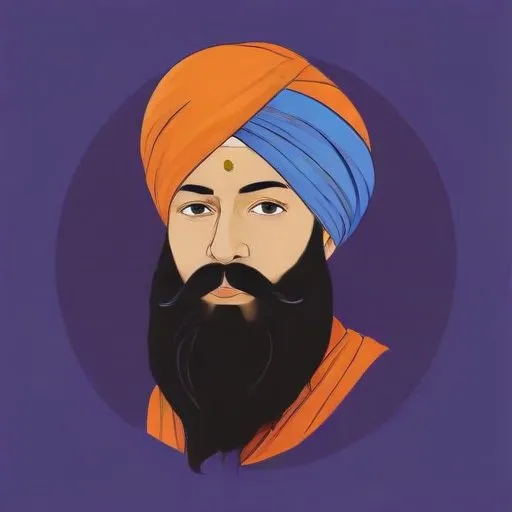
The seventh Sikh Guru, known for his compassion and kindness, healed the son of a Mughal emperor and is revered for his selfless service and devotion to humanity.
Guru Har Rai is revered as the seventh Nanak, the seventh of ten Gurus of the Sikh religion. He is known for maintaining the large army of Sikh soldiers without engaging in military conflict, and for his unwavering commitment to his faith, even in the face of adversity.
Guru Har Rai was born on 16 January 1630, to Ananti (also known as Nihal Kaur) and Baba Gurditta, into a Sodhi Khatri household. His father passed away when he was just 8 years old. At the tender age of 10, he was married to Mata Kishan Kaur (also referred to as Sulakhni), the daughter of Daya Ram. They had one daughter, Rup Kaur, and two sons, Ram Rai and Har Krishan, the latter of whom would go on to become the eighth Guru.
After the death of his grandfather, Guru Hargobind, Guru Har Rai became the Sikh leader at the age of 14, on 3 March 1644. He guided the Sikhs for about 17 years, until his death at the age of 31.
One of Guru Har Rai's most notable achievements was his ability to maintain the large army of Sikh soldiers without engaging in military conflict. He believed in promoting peace and harmony, even in the face of adversity. This was a remarkable feat, given the tumultuous times in which he lived.
Guru Har Rai supported the moderate Sufi-influenced Dara Shikoh, instead of the conservative Sunni-influenced Aurangzeb, as the two brothers entered into a war of succession to the Mughal Empire throne. After Aurangzeb won the succession war in 1658, he summoned Guru Har Rai in 1660 to explain his support for the executed Dara Shikoh.
Guru Har Rai sent his elder son, Ram Rai, to represent him. However, Aurangzeb kept Ram Rai as a hostage and questioned him about a verse in the Adi Granth, the holy text of the Sikhs at that time. Aurangzeb claimed that the verse disparaged Muslims. Ram Rai, in an attempt to appease Aurangzeb, changed the verse, an act that Guru Har Rai never forgave.
Guru Har Rai was deeply disappointed by Ram Rai's actions and excommunicated him. He nominated his younger son, Har Krishan, to succeed him as the eighth Guru. This decision was a testament to Guru Har Rai's unwavering commitment to his faith and his refusal to compromise on his values.
Guru Har Rai's legacy is one of courage, conviction, and compassion. He demonstrated remarkable leadership skills, maintaining the Sikh army without engaging in military conflict, and promoting peace and harmony in the face of adversity.
His decision to excommunicate Ram Rai and nominate Har Krishan as his successor demonstrated his commitment to upholding the values of the Sikh faith. His legacy continues to inspire generations of Sikhs around the world.
Guru Har Rai's philosophical contributions are a testament to his deep understanding of the Sikh faith. He emphasized the importance of living a simple life, free from worldly desires, and encouraged his followers to cultivate a sense of compassion and empathy.
His teachings stressed the importance of selfless service, hard work, and devotion to the Guru. He also emphasized the importance of education, encouraging his followers to acquire knowledge and wisdom.
"The true way to avoid sin is to remember the Name of the Lord, and to eradicate ego from the mind."
"The devotee who is imbued with the love of the Lord, does not feel any attachment to worldly affairs."
"The Sikh is he who has the fear of God in his heart, and who is saturated with the love of the Lord."
Born in 1666
A spiritual leader who founded the Sikh warrior community and wrote poetic compositions that are still revered today, known for his bravery and spiritual guidance.
Born in 1479
The third Sikh Guru, a key figure in Sikhism, is known for establishing the Sikh holy city of Amritsar and introducing the concept of langar, a communal kitchen where people of all faiths and backgrounds can eat together.
Born in 1534
The fourth Sikh Guru is known for composing the Laava, the four hymns of the Sikh marriage ceremony, and for designing the Golden Temple in Amritsar, India. They played a crucial role in shaping Sikhism's spiritual and cultural practices.
Born in 1469
Founded Sikhism, a religion that emphasizes spiritual growth, social justice, and equality, and is revered for his poetic hymns and teachings that promote love, compassion, and devotion.
