


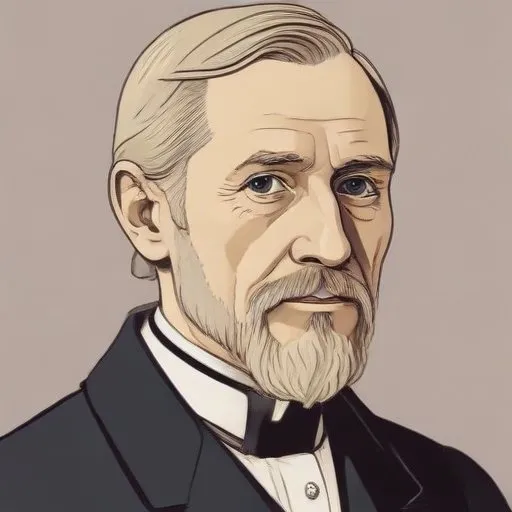
A Finnish linguist and diplomat who studied and documented the Mongolian and Manchu-Tungusic languages, making significant contributions to the field of Altaic languages.
Gustaf John Ramstedt was a Finnish diplomat, orientalist, and linguist who left an indelible mark on the world of Altaic languages. He is renowned for his groundbreaking research on Mongolian languages and his efforts to promote the independence of Mongolia from Chinese rule.
Born on October 22, 1873, in Ekens, Southern Finland, Ramstedt was part of a prominent family of scholars and politicians. His brother, Armas Ramstedt, was a professor of linguistics and occidentalist, while his brother Emanuel Ramstedt was a politician. He pursued his undergraduate studies at the University of Helsinki, where he delved into the world of Finno-Ugric languages under the guidance of Eemil Nestor Setälä.
Ramstedt's fascination with Altaic languages took him to Mongolia, where he studied the Mongolian language at the suggestion of Otto Donner. This marked the beginning of his lifelong passion for understanding the complexities of Altaic languages. He later became a professor extraordinarius in Altaic languages at the University of Helsinki.
Ramstedt's expeditions in Mongolia led to a profound friendship with the highly educated Buryat Mongol, Agvan Dorzhiev. Dorzhiev, who acted as the full representative of the 13th Dalai Lama, Thubten Gyatso, and was a member of the Tibetan Government, introduced Ramstedt to the intricacies of Mongolian politics. Ramstedt's relationships with the Mongolians earned him an invitation to visit Lhasa, although the event was unfortunately thwarted by unforeseen circumstances.
In 1911, the Mongolian delegation in St. Petersburg asked Ramstedt to mediate between the Mongolian representatives and the Imperial Russian government to secure support for Mongolian independence from Chinese rule. Ramstedt successfully convinced the Russians to supply the Mongolians with 15,000 modern rifles, which enabled them to initiate an uprising against the Chinese.
In 1912, Ramstedt was instrumental in negotiating with the Russian representatives on behalf of the Mongol leaders, Da Lama, Chin Van Khanddorj, and Haisan Gung. Although the Mongolians' vision of a unified Mongol state was not realized, Ramstedt's diplomatic efforts paved the way for Mongolia's eventual independence.
Gustaf John Ramstedt's remarkable journey through the realms of Altaic languages, diplomacy, and politics has left an indelible mark on the world. His groundbreaking research, his friendships, and his diplomatic efforts have shaped our understanding of the complex relationships between nations and cultures. Today, Ramstedt's legacy serves as a testament to the power of dedication, passion, and cross-cultural understanding.
Born in 1900
A Finnish leader who served as President from 1956 to 1982, known for maintaining Finland's neutrality during the Cold War and fostering good relations with the Soviet Union.
89 Years Old
A Finnish statesman and Nobel laureate who served as President of Finland and mediated several international conflicts, earning him the Nobel Peace Prize in 2008.
