


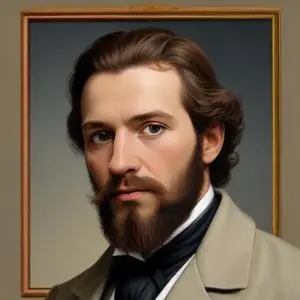
A French painter and academic, renowned for his dreamlike, Symbolist works that blended mythology and mysticism, influencing the development of Art Nouveau.
Gustave Moreau, a French artist, is renowned for his pivotal role in the Symbolist movement, earning him the title of "the Symbolist painter par excellence." With a prolific career spanning over four decades, Moreau created an astonishing 15,000 paintings, watercolors, and drawings that continue to inspire and intrigue art enthusiasts to this day.
Born in Paris on April 6, 1826, Moreau demonstrated a natural aptitude for drawing from a young age. He received a solid education at Collège Rollin (now Collège Jacques-Decour) and went on to study painting at the prestigious École des Beaux-Arts.
In the early 1850s, Moreau formed a close friendship and mentorship with Théodore Chassériau, a prominent painter of the time. Chassériau's untimely death in 1856 had a profound impact on Moreau, leading him to travel to Italy from 1857 to 1859. During this period, Moreau created hundreds of copies and studies of Old Master paintings, which would later influence his unique style.
Moreau's artistry reached new heights with his Symbolist works, which often featured allegorical and mythological subjects. His painting, "Jupiter and Semele," is particularly notable for its use of Symbolist polyvalence. Art historian Robert Delevoy praised this work, stating that it brought Symbolist polyvalence to its highest point.
Moreau's depictions of female characters from the Bible and mythology are iconic and have become synonymous with the Symbolist movement. These enigmatic figures, imbued with mystery and complexity, have captivated art lovers and inspired generations of artists.
Although Moreau's work fell out of favor in the early 20th century, his Symbolist masterpieces experienced a resurgence in popularity in the 1960s and 1970s. Today, he is recognized as one of the most paramount Symbolist painters, with his art continuing to inspire and influence contemporary artists.
Moreau's Symbolist legacy extends beyond the art world, influencing literature, music, and film. His work has inspired writers like J.K. Huysmans, who praised Moreau's ability to breathe new life into worn-out mythological subjects.
In conclusion, Gustave Moreau's pioneering work in the Symbolist movement has left an indelible mark on the world of art, continuing to captivate and inspire generations of artists, writers, and enthusiasts alike.
Born in 1840
A French Symbolist master of the bizarre and fantastical, creating dreamlike paintings and lithographs that explored the realm of the irrational and the unknown.
Born in 1824
A French painter and illustrator who created dreamy, Symbolist works that blended classical and modern styles, influencing the development of Art Nouveau and beyond.
Born in 1860
A pioneering artist who blended satire and fantasy to create vibrant, unsettling works that paved the way for avant-garde movements. His innovative style and themes continue to inspire artists and designers today.
Born in 1863
A Norwegian painter who created iconic, emotionally charged works that explored the human experience, including the famous piece "The Scream".
Born in 1798
A Romantic-era master of expressive brushstrokes and vivid color, creating iconic works that captured the drama and emotion of historical and literary scenes.
Born in 1791
A Romantic-era master of dramatic and emotionally charged art, known for his powerful depictions of horses and the human experience.
Born in 1780
A renowned French Neoclassicist painter and illustrator, celebrated for his exquisite portraits and historical scenes that epitomize elegance and refinement. His work continues to inspire artists and art enthusiasts alike.
Born in 1839
A post-Impressionist pioneer, he's famous for his still-life compositions and landscapes that laid the groundwork for Cubism, influencing 20th-century art.
