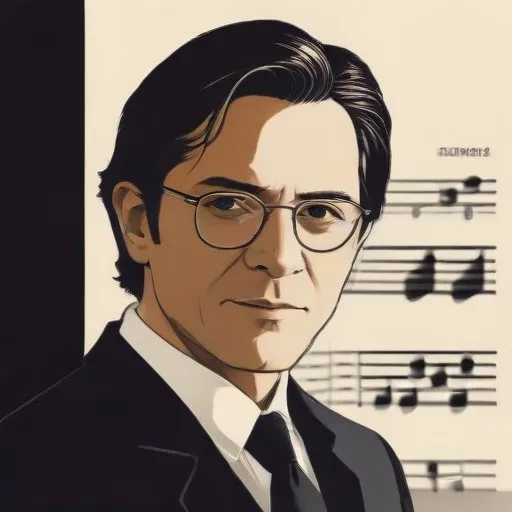
Gustavo BecerraSchmidt: The Visionary Composer Who Brought Avant-Garde Music to Chile
A Pioneering Spirit in Chilean Music
Gustavo BecerraSchmidt, a renowned Chilean composer, was a trailblazer who introduced avant-garde music to his homeland, leaving an indelible mark on the country's cultural landscape. Born on August 26, 1925, in Temuco, Chile, BecerraSchmidt's life was a testament to his passion for music and his commitment to pushing boundaries.
The Early Years: Laying the Foundation
BecerraSchmidt's musical journey began at The Chilean National Conservatory, where he was mentored by the illustrious Pedro Humberto Allende. This foundation in traditional music would later serve as a springboard for his exploration of avant-garde styles.
A European Sojourn: Absorbing the Avant-Garde
In 1953, BecerraSchmidt embarked on a three-year journey to Europe, where he immersed himself in the cutting-edge music scene. This exposure to the avant-garde movement had a profound impact on his artistic vision, and he returned to Chile in 1956, determined to share this new perspective with his compatriots.
A Champion of Chilean Music
In 1959, BecerraSchmidt became the director of the Instituto de Extension Musical (IEM), a prestigious institution founded by Domingo Santa Cruz to promote and preserve Chilean music. During his tenure, he played a crucial role in centralizing and managing the national music repertoire, providing a platform for Chilean composers to showcase their work.
A Teacher and Mentor
BecerraSchmidt's influence extended beyond his compositions to the next generation of Chilean musicians. As a teacher at the Chilean National Conservatory, he nurtured the talents of some of the country's most prominent composers, including Luis Advis, Sergio Ortega, Fernando Garca, and Cirilo Vila.
A Life in Exile: The 1973 Coup and Its Aftermath
Following the 1973 Chilean coup d'état, BecerraSchmidt was forced into exile, relocating to Germany in 1974. Despite the challenges, he continued to compose and teach, sharing his expertise with students at the University of Oldenburg.
Compositions: A Diverse and Prolific Output
BecerraSchmidt's oeuvre is a testament to his creative vitality, encompassing hundreds of compositions that span traditional, avant-garde, and aleatoric styles. His cantatas, symphonies, and oratorios often explored themes related to Chile's rich cultural heritage, including the Pre-Columbian era and Spanish colonization.
Notable Works
- La Araucana, a cantata that weaves together the threads of Chile's indigenous past
- Lord Cochrane de Chile, a powerful oratorio that celebrates the country's naval hero
- Macchu Picchu, a majestic oratorio set to texts by Pablo Neruda, capturing the essence of Chile's most iconic landmark
- Concerto for Flute and Strings, a virtuosic showcase for the flute
- Harp Concerto, a lyrical and evocative work that highlights the instrument's expressive range
A Lasting Legacy
Gustavo BecerraSchmidt's impact on Chilean music is immeasurable. His tireless efforts to promote the country's cultural heritage, combined with his innovative compositions, have inspired generations of musicians and composers. Through his life and work, he has left an indelible mark on the country's musical landscape, ensuring that his legacy will continue to resonate for years to come.
FAQ
What is Gustavo Becerra-Schmidts most famous composition?
Gustavo Becerra-Schmidts most famous composition is his Sinfonía No. 1, a symphony that premiered in 1963 and is considered one of the most important works of Chilean chamber music.
What was Gustavo Becerra-Schmidts compositional style?
Gustavo Becerra-Schmidts compositional style was characterized by a fusion of modernist and neoclassical elements, with a strong emphasis on rhythm and timbre. He was also influenced by Chilean folk music and incorporated elements of it into his compositions.
What awards did Gustavo Becerra-Schmidt win?
Gustavo Becerra-Schmidt won several awards for his compositions, including the Chilean National Prize for Music, the Santiago Municipal Prize, and the award for Best Composer at the 1965 Chilean Music Festival.
What was Gustavo Becerra-Schmidts role in Chilean music education?
Gustavo Becerra-Schmidt was a prominent figure in Chilean music education, serving as a professor of composition and theory at the University of Chile and the Chilean Conservatory of Music. He also founded the Chilean Musicological Society.
What is Gustavo Becerra-Schmidts legacy in Chilean music?
Gustavo Becerra-Schmidts legacy in Chilean music is that of a pioneering composer who helped shape the countrys musical identity. His works are considered some of the most important in Chilean classical music and continue to be performed and celebrated today.