


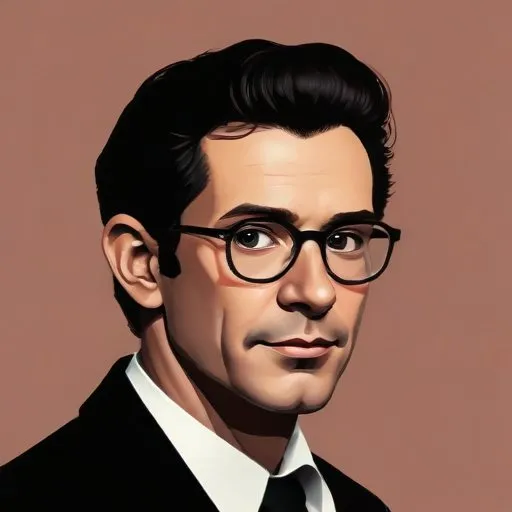
A renowned literary critic, translator, and fiction writer, known for his eclectic and erudite short stories that blend mythology, history, and philosophy.
Guy Davenport was a polymathic American writer, translator, illustrator, painter, intellectual, and teacher, renowned for his eclectic body of work that defied categorization. He was a master of language, art, and ideas, whose creative output spanned multiple genres and disciplines, leaving an indelible mark on modern literature and culture.
Born on November 23, 1927, in Anderson, South Carolina, Davenport grew up in the foothills of Appalachia, where he developed a passion for reading and storytelling. He began writing his own stories and drawing illustrations at the age of 11, and by 13, he was devouring books on a range of subjects, including art and literature.
After leaving high school early, Davenport enrolled at Duke University, where he studied art with Clare Leighton and graduated summa cum laude in classics and English literature. He was elected to Phi Beta Kappa in his junior year, a testament to his academic excellence.
As a Rhodes Scholar at Merton College, Oxford, Davenport studied Old English under the tutelage of J.R.R. Tolkien, graduating with a B.Litt. in 1950. His thesis on James Joyce reflected his burgeoning interest in modernist literature.
After serving in the US Army for two years, Davenport returned to academia, teaching at Washington University in St. Louis and later pursuing his Ph.D. at Harvard, where he studied under Harry Levin and Archibald MacLeish.
Davenport's literary circle was a who's who of modernist luminaries. He befriended Ezra Pound during the poet's incarceration at St. Elizabeths Hospital, visiting him annually until Pound's release in 1958. This friendship led to a deep appreciation for Pound's poetry, which Davenport explored in his dissertation, later published as Cities on Hills in 1983.
Another significant literary connection was with Hugh Kenner, who became a close friend and kindred spirit. Their correspondence and conversations deeply influenced Davenport's own writing and intellectual pursuits.
Davenport's writing was characterized by its innovative style, which blended elements of fiction, nonfiction, and poetry. His short stories, essays, and translations showcased his erudite knowledge and playful approach to language. Notable works include The Jules Verne Steam Balloon, Eclogues, and The Hunter Gracchus.
As an illustrator and painter, Davenport's artistic style was marked by its lyricism and whimsy. His visual work often accompanied his writings, creating a unique synergy between word and image.
Throughout his career, Davenport taught at various institutions, including the University of Kentucky, where he held a professorship in English literature. He was a dedicated mentor, inspiring generations of writers, artists, and scholars to pursue their passions with intellectual curiosity and creative fervor.
Davenport received numerous awards and accolades for his contributions to literature and education. He was a recipient of the MacArthur Fellowship, the Lila Wallace-Reader's Digest Writers' Award, and the O.B. Hardison Jr. Poetry Prize, among others.
Davenport's intellectual pursuits were guided by a deep appreciation for the interconnectedness of art, literature, and philosophy. He believed that creative expression was a fundamental aspect of human experience, one that could bridge cultural and disciplinary divides.
In his writing and teaching, Davenport championed the importance of interdisciplinary learning, advocating for a holistic approach to education that integrated the arts, humanities, and sciences.
Throughout his life, Davenport navigated the complexities of modernity, balancing his creative passions with the demands of academia and public life. His relationships with fellow writers, artists, and intellectuals shaped his work and worldview, leaving a lasting impact on the literary landscape.
Guy Davenport's remarkable legacy continues to inspire readers, writers, and scholars today, a testament to the power of creativity, intellectual curiosity, and the pursuit of knowledge.
Born in 1885
A pioneering modernist poet and critic who transformed 20th-century literature with innovative styles and provocative ideas, shaping the course of modern poetry.
Born in 1888
A renowned poet, playwright, and critic who reshaped modern poetry with works like "The Waste Land" and "Old Possum's Book of Practical Cats", influencing literature and art with their unique style.
Born in 1882
A pioneering modernist writer, known for experimental novels and short stories that explore the human experience, particularly in Dublin, Ireland. His works are celebrated for their complex, lyrical prose and innovative narrative structures.
Born in 1882
A pioneering author of modernist literature, known for experimental novels and essays that explored the human experience, blurring the lines between reality and fiction.
Born in 1899
A legendary writer who crafted sparse, powerful prose, capturing the human experience in novels like "The Old Man and the Sea" and "A Farewell to Arms".
Born in 1896
Author of novels and short stories that capture the essence of the Jazz Age, exploring themes of wealth, class, and the American Dream. Known for timeless classics like "The Great Gatsby" and "Tender Is the Night".
Born in 1897
A Nobel Prize-winning author of complex, psychologically rich novels and short stories that explore the American South's troubled history and human nature. His writing style, blending stream-of-consciousness and non-linear narrative, has influenced generations of writers.
Born in 1896
A pioneering writer of the Lost Generation, known for experimental novels that capture the spirit of early 20th-century America, blending fiction and journalism.
