


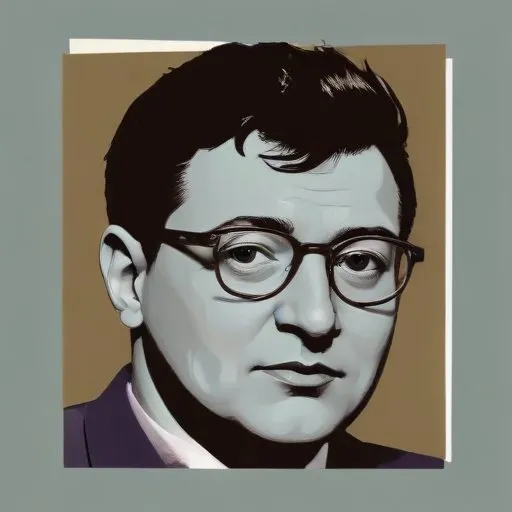
A French theorist and author who developed the concept of "spectacle," arguing that modern society is shaped by the consumption of images and commodities, leading to a loss of authentic human experience.
French philosopher, Marxist theorist, and filmmaker Guy Debord is best known for his groundbreaking 1967 essay, The Society of the Spectacle, a scathing critique of modern society and consumer culture.
This influential work cemented Debord's reputation as a leading thinker of his time, and its ideas continue to resonate with contemporary audiences.
Debord was born on December 28, 1931, in Paris, France. After his father's early death, he was sent to live with his grandmother in Italy, where he developed a passion for film and vandalism.
During World War II, Debord's family traveled extensively, eventually settling in Cannes, where he attended high school and began to oppose the French war in Algeria.
In his late teens, Debord joined the Lettrist International, a radical avant-garde movement led by Isidore Isou. However, a schism within the group led to Debord's faction, the Letterist International, which he led alongside Gil Wolman.
In 1957, Debord co-founded the Situationist International (SI), a collective of artists, intellectuals, and revolutionaries who sought to transform modern society. The SI's emphasis on critical theory, avant-garde art, and revolutionary politics echoed Debord's own philosophical concerns.
Debord's The Society of the Spectacle is a seminal work of critical theory that critiques the ways in which modern society is shaped by the pursuit of economic growth, consumerism, and the spectacle of media and entertainment.
This influential text has been hailed as a catalyst for the 1968 Paris uprising, during which Debord participated in the occupation of the Sorbonne.
Debord's philosophical ideas centered around the notion of the "spectacle," which he saw as a system of social control that reinforces capitalist domination and alienation.
He advocated for a revolutionary transformation of society, emphasizing the importance of individual autonomy, creative expression, and collective action.
Debord's ideas have had a profound impact on various fields, from sociology and cultural studies to art and architecture. His critique of modern society and consumer culture continues to inspire contemporary thinkers and activists.
Debord's ideas continue to inspire contemporary thinkers, artists, and activists, influencing fields such as sociology, cultural studies, and critical theory.
His critique of modern society and consumer culture remains a powerful tool for understanding the complexities of our contemporary world.
Through his work, Debord has left an indelible mark on modern thought, challenging us to question the very foundations of our society and to imagine a world beyond the spectacle.
97 Years Old
A French sociologist and philosopher who developed theories on consumerism, hyperreality, and the simulation of reality, arguing that our postmodern world is more concerned with images and appearances than reality itself.
99 Years Old
A French historian and philosopher who critiqued power structures and social norms, arguing that knowledge and truth are shaped by those in power. He's known for his concepts of power, discipline, and surveillance.
Born in 1925
A French philosopher who developed influential concepts like "rhizome" and "desire-machines," which challenged traditional notions of identity, reality, and power.
96 Years Old
A French psychotherapist and philosopher who developed the concept of "schizoanalysis," a critical perspective on capitalism and its effects on desire and subjectivity. He's also known for his collaborations with Gilles Deleuze, particularly their influential book "A Thousand Plateaus."
