


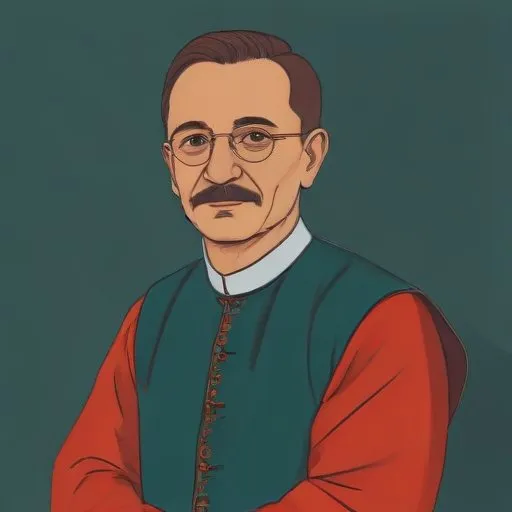
A Hungarian composer and academic renowned for his innovative and expressive musical compositions that blended modernism with traditional folk elements. His works often featured complex rhythms and dissonant harmonies.
Gyrgy Kurtg is renowned for his profound contribution to contemporary classical music, characterized by a unique compression of scale and forces, and an unwavering immediacy of expression. With a style that draws on the likes of Bartok, Webern, and Stravinsky, Kurtg's work has been hailed as a cornerstone of the European avant-garde movement.
Born on February 19, 1926, in Lugoj, Romania, to Jewish Hungarian parents, Kurtg's earliest exposure to music was through piano lessons with Magda Kardos. He later pursued composition studies with Max Eisikovits in Timisoara, before moving to Budapest in 1946 to become a Hungarian citizen.
At the Franz Liszt Academy of Music, Kurtg met his future wife, Márta Kinsker, and the influential composer György Ligeti. Under the guidance of renowned professors, including Sándor Veress and Ferenc Farkas, Kurtg honed his skills in composition, piano, and chamber music, graduating in 1951 and later receiving his degree in composition in 1955.
Following the Hungarian uprising in 1956, Kurtg's time in Paris between 1957 and 1958 proved transformative. He studied with luminaries such as Max Deutsch, Olivier Messiaen, and Darius Milhaud. However, this period was also marked by Kurtg's struggles with severe depression. He has spoken candidly about this dark phase, stating, "I realized to the point of despair that nothing I had believed to constitute the world was true."
It was during this time that Kurtg sought therapy from art psychologist Marianne Stein, who encouraged him to rebuild his music from the simplest elements. This encounter revitalized Kurtg, stimulating a creative rebirth that would shape his future works.
Kurtg's academic pursuits extend beyond his own education. He taught piano at the Franz Liszt Academy of Music from 1967, later adding chamber music to his teaching repertoire, until his retirement in 1993. Through his pedagogy, Kurtg influenced generations of musicians, imparting his unique perspective and passion for innovative music.
Kurtg's oeuvre is characterized by a diverse range of works, from solo piano pieces to large-scale orchestral compositions. Some of his most notable works include:
Gyrgy Kurtg's impact on modern classical music is undeniable. His unique compositional style, marked by a focus on simplicity and immediacy, has inspired a wide range of musicians and composers. As one of the last living links to the defining post-war composers of the European avant-garde, Kurtg's legacy continues to shape the musical landscape.
In 2023, Kurtg remains an iconic figure, celebrated for his tireless pursuit of innovation and his dedication to the world of classical music.
Born in 1923
A visionary composer and educator who pushed the boundaries of classical music with his avant-garde and innovative works, blending dissonance and harmony in unique ways.
Born in 1925
A renowned French musician who revolutionized classical music with his avant-garde compositions and innovative conducting style, pushing boundaries and redefining the genre.
98 Years Old
A pioneer of electronic and avant-garde music, this composer pushed boundaries with unconventional sounds and performances, influencing generations of musicians and artists.
Born in 1922
A visionary composer who merged mathematics and music, creating complex, avant-garde works that pushed the boundaries of sound and performance.
Born in 1908
A pioneering composer of modern classical music, known for his complex and innovative works that pushed the boundaries of harmony and rhythm.
Born in 1913
A Polish composer and conductor who blended modernist and neoromantic styles, creating complex yet accessible orchestral works, including symphonies and concertos.
Born in 1916
A renowned French pianist, composer, and educator, he was a prominent figure in 20th-century classical music, celebrated for his unique and innovative compositions.
87 Years Old
A renowned oboist, composer, and conductor, celebrated for his virtuosic performances and innovative compositions that blended classical and modern styles. He's a leading figure in contemporary classical music.
