


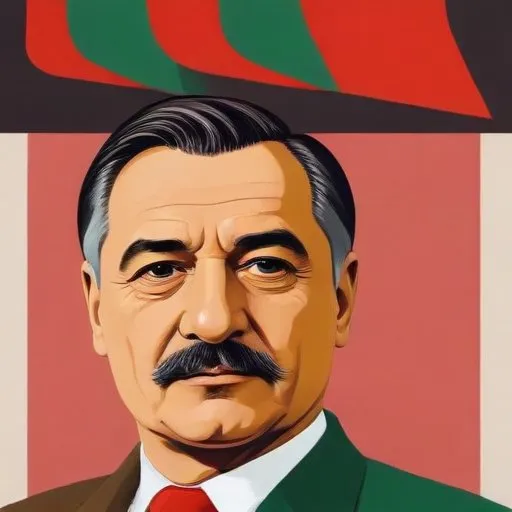
Led the Hungarian government during a period of relative liberalization, implementing reforms and increasing autonomy from Soviet control. Known for his role in shaping Hungary's path towards democratization.
Gyula Kllai, a name synonymous with Hungarian politics, is best known for his tenure as Chairman of the Council of Ministers of the People's Republic of Hungary from 1965 to 1967, and later as Speaker of the National Assembly of Hungary from 1967 to 1971.
Born on June 1, 1910, Kllai's fascination with communism began at a young age, leading him to dedicate his life to the cause. He was a stalwart supporter of Marxist-Leninist ideology, which shaped his political beliefs and actions throughout his career.
Kllai's rise to prominence began in 1957, when he was appointed President of the National Council of the Patriotic People's Front, a position he held until 1989. This role allowed him to shape the country's political landscape and solidify his influence within the Communist Party.
Kllai's involvement in the Imre Nagy affair in 1957 sparked controversy and criticism from many. He visited Nagy, the former Hungarian prime minister, in exile in Snagov, Romania, and his subsequent report led to Nagy's execution. Kllai's pamphlet, The Counter-Revolution in Hungary in the Light of Marxism-Leninism, further solidified his stance on Nagy's perceived mistakes.
From 1967 to 1971, Kllai served as Speaker of the National Assembly of Hungary, where he worked to implement communist policies and maintain the party's grip on power. His leadership skills and unwavering commitment to the communist ideology earned him respect and admiration from his peers.
Kllai's contributions to Hungarian politics and communism have left an indelible mark on the country's history. While his actions were often shrouded in controversy, his devotion to the communist cause remains undeniable. As a pivotal figure in Hungary's post-war era, Kllai's legacy continues to fascinate and intrigue historians and political enthusiasts alike.
Little is known about Kllai's personal life, but his public persona was marked by a sense of gravitas and seriousness. His focus on politics often eclipsed his personal relationships and interests, leading some to view him as enigmatic and mysterious.
In conclusion, Gyula Kllai's life was a testament to his unwavering dedication to communism and his role in shaping Hungary's political landscape. While controversy often surrounded him, his legacy remains a fascinating chapter in the country's history.
Born in 1892
A Hungarian communist leader who ruled the country with an iron fist from 1949 to 1956, known for his brutal suppression of dissent and forced industrialization.
Born in 1912
A Hungarian mechanic-turned-politician who served as Prime Minister of Hungary from 1956 to 1988, known for his role in crushing the 1956 Hungarian Revolution and later introducing economic reforms.
Born in 1896
Led a reformist government in Hungary during the 1956 revolution, attempting to establish a multi-party system and withdraw from the Soviet-dominated Warsaw Pact. His efforts ultimately led to Soviet invasion and his execution.
Born in 1886
Led a communist government in Hungary after World War II, implementing Soviet-style policies and suppressing opposition. He played a key role in the country's post-war reconstruction and alignment with the Soviet Union.
