


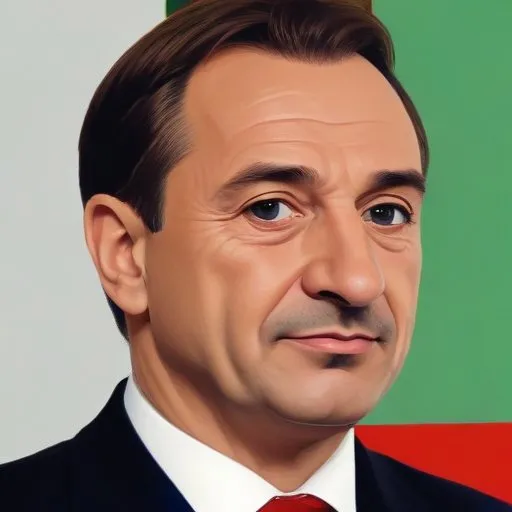
A Hungarian mechanic-turned-politician who served as Prime Minister of Hungary from 1956 to 1988, known for his role in crushing the 1956 Hungarian Revolution and later introducing economic reforms.
In the tumultuous landscape of Hungarian politics, one name stands out for his unwavering commitment to Realpolitik: Jnos Kdr, the General Secretary of the Hungarian Socialist Workers' Party who held the reins of power for an unprecedented 32 years.
Born Jnos Jzsef Czermanik on May 26, 1912, in Fiume, Hungary, Kdr's early life was marked by poverty and hardship. His mother, a single parent, raised him in the countryside before moving to Budapest, where he would later join the Party of Communists in Hungary's youth organization, KIMSZ.
Kdr's ascent to power was nothing short of meteoric. He became a prominent figure in the pre-1939 Communist party, eventually becoming First Secretary. After World War II, with Soviet support, the Communist party took power in Hungary, and Kdr rose through the ranks, serving as Interior Minister from 1948 to 1950.
Kdr's leadership was characterized by his ability to maneuver between Moscow's wishes, local interests, and the expectations of the Western world. In an interview with a Western journalist, he called himself a "toiler for compromise." This pragmatic approach allowed him to maintain a delicate balance of power, earning him the respect of both his allies and adversaries.
In 1956, during the Hungarian Revolution, Kdr replaced Ern Ger as General Secretary of the Party, taking part in Imre Nagy's revolutionary government. However, just a week later, he broke with Nagy over his decision to withdraw from the Warsaw Pact. After Soviet intervention in Hungary, Kdr was selected to lead the country, and he ordered Nagy's execution shortly after coming to power.
Despite his initial hardline stance, Kdr gradually moderated, releasing the majority of remaining prisoners of this period in an amnesty in 1963. This move marked a significant shift in his leadership style, as he began to prioritize stability and pragmatism over ideological purity.
Kdr's 32-year tenure as General Secretary of the Hungarian Socialist Workers' Party is a testament to his political acumen and ability to adapt to changing circumstances. While his leadership was not without controversy, his commitment to compromise and pragmatism helped to maintain a fragile peace in Hungary during a tumultuous period in world history.
Kdr's personal life was marked by simplicity and humility. He remained committed to his wife, Mária Tamási, throughout his life, and the couple had two children together.
In his later years, Kdr's health began to decline, leading to his retirement in 1988. He was succeeded by Kroly Grsz as General Secretary and passed away on July 6, 1989, after being hospitalized for pneumonia.
Kdr's leadership had a profound impact on modern society, both in Hungary and beyond. His commitment to Realpolitik and compromise helped to maintain a delicate balance of power during the Cold War era, and his willingness to adapt to changing circumstances paved the way for Hungary's transition to democracy in the late 1980s.
Today, Kdr's legacy continues to shape Hungarian politics, and his commitment to pragmatism remains an important part of the country's political DNA.
Born in 1912
A Hungarian mechanic-turned-politician who served as Prime Minister of Hungary from 1956 to 1988, known for his role in crushing the 1956 Hungarian Revolution and later introducing economic reforms.
Born in 1892
A Hungarian communist leader who ruled the country with an iron fist from 1949 to 1956, known for his brutal suppression of dissent and forced industrialization.
Born in 1896
Led a reformist government in Hungary during the 1956 revolution, attempting to establish a multi-party system and withdraw from the Soviet-dominated Warsaw Pact. His efforts ultimately led to Soviet invasion and his execution.
Born in 1886
Led a communist government in Hungary after World War II, implementing Soviet-style policies and suppressing opposition. He played a key role in the country's post-war reconstruction and alignment with the Soviet Union.
93 Years Old
The 37th Prime Minister of Hungary, serving from 1994 to 1998, known for his efforts to transition the country from communism to a market economy and joining NATO. He implemented significant economic reforms and played a key role in Hungary's integration into Western institutions.
