


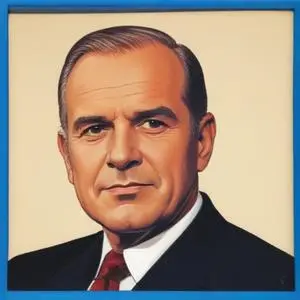
A powerful and influential White House Chief of Staff who served under President Richard Nixon, known for his role in the Watergate scandal and subsequent cover-up.
H. R. Haldeman, also known as "The Berlin Wall," was the chief of staff to President Richard Nixon, serving from 1969 to 1973. His name is synonymous with the Watergate scandal, which led to Nixon's resignation and Haldeman's own imprisonment.
Born on October 27, 1926, in California, Haldeman served in the Navy Reserves during World War II and later attended UCLA. After graduating, he joined the J. Walter Thompson advertising agency, where he worked his way up to become a prominent executive in both Los Angeles and New York City.
Haldeman's foray into politics began in the 1950s, when he became acquainted with Richard Nixon. He worked on Nixon's 1960 presidential campaign and later managed his 1962 gubernatorial campaign in California. When Nixon was elected President in 1968, he tapped Haldeman as his chief of staff.
Haldeman is credited with implementing significant changes to White House staffing systems and Executive Branch governance and operations. His reforms streamlined the decision-making process, making the President's office more efficient and effective. The "Haldeman system" remains in place to this day, with subsequent presidential administrations adopting his innovative approach.
Haldeman's reputation as a stern taskmaster and Nixon's loyal right-hand man earned him both admiration and criticism. However, his involvement in the Watergate cover-up led to his downfall. He was tried and found guilty of perjury, conspiracy, and obstruction of justice, serving 18 months in prison.
After his release from prison, Haldeman returned to private life and became a successful businessman and real estate developer. He remained a private figure until his death from cancer on November 12, 1993.
Haldeman's legacy is complex, marked by both significant achievements and grave mistakes. While his contributions to the Nixon administration's efficiency and effectiveness are undeniable, his role in the Watergate scandal will always be a stain on his reputation. Nonetheless, his impact on American politics and governance endures.
"You've got to believe in the president, and I do."
— H. R. Haldeman
Haldeman's story serves as a cautionary tale about the dangers of unchecked power and blind loyalty. His rise and fall from grace offer valuable insights into the inner workings of the Nixon administration and the consequences of political corruption.
Born in 1913
The 37th President of the United States, a polarizing figure who led the country through significant domestic and foreign policy changes, infamous for his involvement in the Watergate scandal.
Born in 1923
A renowned diplomat and strategist who played a pivotal role in shaping global politics during the Cold War era, known for his Realpolitik approach and brokering peace agreements .
Born in 1913
The 38th President of the United States, a former football star and lawyer, is known for being the first vice president to assume the presidency under the 25th Amendment and for his controversial pardon of Richard Nixon. He's also remembered for his humble and accidental rise to the presidency.
Born in 1918
The 39th Vice President of the United States, a politician embroiled in scandal, resigning amidst corruption charges, forever tainting his legacy. He's infamous for being the first VP to resign due to criminal conduct.
Born in 1925
A key advisor to President Nixon, serving as White House Counsel and playing a central role in the Watergate scandal. He was convicted of conspiracy, obstruction of justice, and perjury.
Born in 1924
The 59th United States Secretary of State, a four-star general who played a key role in the Nixon administration and later served as a diplomat, known for his controversial and influential decisions during the Cold War era.
Born in 1917
A decorated military officer and lawyer who served as Secretary of Defense, playing a key role in shaping US foreign policy and military strategy during the Cold War. He's most known for his hawkish stance and significant military budget increases.
