


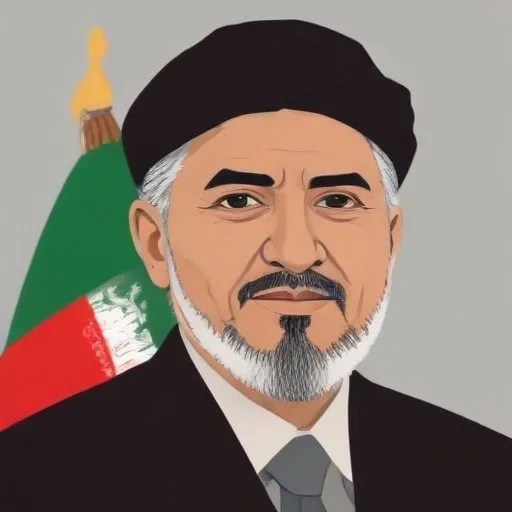
Afghan educator and politician who served as Minister of Foreign Affairs, known for his role in the Soviet-backed communist government and his eventual assassination in 1979.
Hafizullah Amin is renowned for masterminding the 1978 Saur Revolution, which overthrew the government of Mohammad Daoud Khan and established a pro-Soviet state in Afghanistan. As the leader of the Democratic Republic of Afghanistan (DRA), Amin's brief but tumultuous tenure was marked by radical reforms, brutal suppression of opposition, and a fraught relationship with the Soviet Union.
Hafizullah Amin was born on August 1, 1929, in the town of Paghman, Kabul Province. He pursued higher education at Kabul University, where he developed an interest in Marxist ideology. Amin's fascination with socialism led him to twice travel to the United States, where he studied at the University of Wisconsin. During this period, he became involved in radical student movements and began to spread socialist ideologies among his peers.
Amin's teaching position in Afghanistan served as a platform for propagating socialist ideas to his students. He joined the Peoples Democratic Party of Afghanistan (PDPA), a far-left organization co-founded by Nur Muhammad Taraki and Babrak Karmal. Although he failed to secure a seat in the 1965 parliamentary election, Amin became the only Khalqist elected to parliament in 1969, increasing his standing within the party.
Amin was the chief orchestrator of the April 1978 Saur Revolution, which toppled the government of Mohammad Daoud Khan. As the second-in-command of the DRA, Amin emerged as the regime's strongman, overseeing the implementation of socialist programs and the persecution of those deemed counter-revolutionary. Amin's growing rift with General Secretary Taraki ultimately led to his ousting and subsequent execution on September 16, 1979.
Amin's short-lived leadership was marked by controversy and brutal suppression of opposition. He assumed the titles of Chairman of the Council of Ministers, Chairman of the Revolutionary Council, and General Secretary of the PDPA Central Committee. Amin's regime was characterized by mass arrests, executions, and forced disappearances of those who opposed his rule.
Amin's regime came to an abrupt end on December 27, 1979, when he was assassinated during the Soviet invasion of Afghanistan. Amin's legacy is complex and multifaceted, with some viewing him as a champion of socialism and modernization, while others regard him as a ruthless dictator responsible for the deaths of thousands of Afghans.
Amin's legacy continues to shape Afghan politics and society. His rise to power and subsequent downfall serve as a cautionary tale about the dangers of authoritarianism and the importance of democratic institutions. Amin's regime also highlights the complex and often fraught relationship between socialism and democracy.
Amin was deeply committed to Marxist-Leninist ideology, which guided his policies and decisions as leader of the DRA. He believed in the need for radical social and economic change to modernize Afghanistan and eliminate class inequalities.
Amin's leadership style and policies can be compared to those of other socialist leaders of the time, such as Fidel Castro of Cuba and Muammar Gaddafi of Libya. While sharing similarities with these leaders, Amin's brutal suppression of opposition and human rights abuses set him apart from more moderate socialist leaders.
Hafizullah Amin's tumultuous reign and tragic demise serve as a poignant reminder of the complexities and challenges of building a socialist state in a deeply conservative society. His legacy continues to shape Afghan politics and society, offering valuable lessons for leaders and policymakers around the world.
Born in 1917
Led the communist People's Democratic Party of Afghanistan and served as President of Afghanistan from 1978 to 1979, implementing radical socialist reforms. He's known for his Marxist-Leninist ideology and tumultuous reign.
Born in 1906
A Soviet leader who ruled with an iron fist, implementing policies that stagnated the economy and suppressed dissent, while also being a key figure in the Cold War. He's infamous for his authoritarian regime and bureaucratic inefficiency.
95 Years Old
The last leader of the Soviet Union, who introduced reforms that led to the end of the Cold War and the collapse of communism, earning a Nobel Peace Prize. He's known for his policies of glasnost and perestroika, which transformed the Soviet Union and the world.
Born in 1904
A Chinese revolutionary and statesman who led the country's economic reforms, transforming it into a global superpower. He's credited with opening up China to the world and introducing capitalist principles.
Born in 1924
A naval officer turned politician who served as the 39th President of the United States, known for his commitment to human rights and social justice, and awarded the Nobel Peace Prize in 2002.
98 Years Old
A Polish-born American strategist and policymaker who served as National Security Advisor, shaping US foreign policy and advising presidents on global affairs. Known for his realist approach and expertise on geopolitics.
