


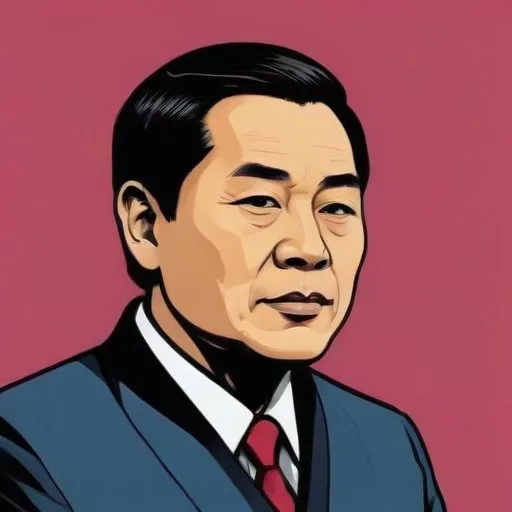
A 16th-century Chinese official who championed fairness and justice, famously speaking truth to power and fighting against corruption. His legacy has inspired generations of Chinese people to stand up for what is right.
Hai Rui, a 16th-century Chinese philosopher and politician, is remembered as a paragon of honesty and integrity in office, earning him the reputation as one of the most revered officials in Chinese history. His unwavering commitment to upholding moral principles, fairness, and poverty has made him a legendary figure in the annals of Chinese bureaucracy.
Hai Rui was born on January 23, 1514, in Haikou City, Hainan, to a Muslim mother from a Hui family with Indian subcontinent ancestry. His great-great-grandfather, Hai Daer, was an Arab, and Hai Rui's fascination with Neo-Confucianism would later shape his philosophical outlook.
Despite his unsuccessful attempts at the Imperial examination, Hai Rui's bureaucratic career began in 1553, when he was 39, as a humble clerk of education in Fujian. His reputation for uncompromising morality, scrupulous honesty, and dedication to fairness earned him widespread popular support.
Hai Rui's unyielding commitment to justice and his refusal to compromise on moral principles caught the attention of the imperial court. In 1565, he submitted a memorial criticizing the Jiajing Emperor for neglecting his duties and bringing disaster to the country. Although this bold move earned him a death sentence in 1566, he was released after the Emperor's death in early 1567.
Under the Longqing Emperor, Hai Rui was reappointed as a minor official serving at South Zhili. However, his overzealous handling of land-tenure issues led to complaints from major moneylenders, and he was forced to resign in 1570.
Hai Rui's philosophical contributions were deeply rooted in Neo-Confucianism, which emphasized personal and governmental morality, correct behavior, and justice. His adherence to these principles guided his official career, earning him the respect of his contemporaries and posterity.
Hai Rui's unwavering commitment to moral principles and his unshakeable integrity in the face of adversity have made him a legendary figure in Chinese history. His legacy continues to inspire generations of Chinese officials and citizens alike, serving as a beacon of hope for a just and fair society.
Hai Rui's life and career were marked by tumultuous times, with the Ming dynasty facing internal strife and external threats. His commitment to moral principles and fairness in the face of adversity has cemented his place as a shining example of integrity in Chinese history.
Hai Rui's legacy extends beyond his own lifetime, inspiring future generations of Chinese officials and citizens to uphold the principles of justice, fairness, and morality. His story serves as a powerful reminder of the importance of integrity in public life and the enduring power of moral principles.
Born in 1893
Leader of the Chinese Communist Party who implemented radical social and economic reforms, including the Great Leap Forward and the Cultural Revolution, shaping modern China's politics and economy.
Born in 1904
A Chinese revolutionary and statesman who led the country's economic reforms, transforming it into a global superpower. He's credited with opening up China to the world and introducing capitalist principles.
Born in 1926
Former Chinese leader who ruled the country from 1989 to 2004, known for his economic reforms and authoritarian grip on power. He's also famous for his "Three Represents" theory, which aimed to broaden the Communist Party's appeal.
83 Years Old
The 5th Paramount leader of China, who served from 2002 to 2012, is known for his role in China's rapid economic growth and his "Scientific Development Concept" policy. He also increased China's global influence through strategic diplomacy.
73 Years Old
The supreme leader of China, overseeing the country's rapid economic growth and asserting its global influence, while consolidating power and cracking down on dissent.
Born in 1898
The first Premier of the People's Republic of China, serving from 1949 until his death in 1976, is most known for his key role in the Chinese Communist Party and his diplomatic efforts to improve relations with the West. He played a crucial part in shaping China's foreign policy and economy during a pivotal period in the country's history.
