


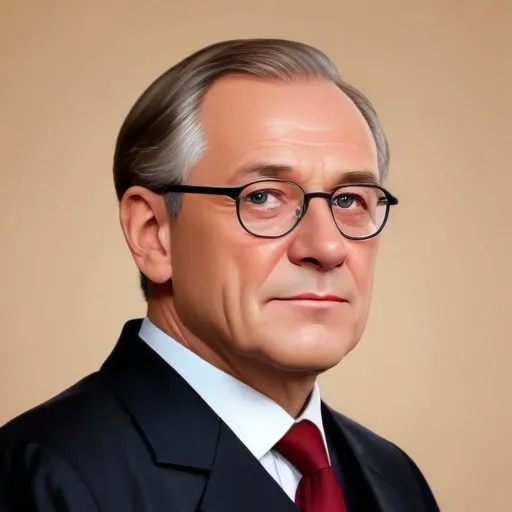
A German lawyer and politician who served as the 23rd President of the European Parliament, known for promoting European integration and unity. He played a key role in shaping the EU's policies and institutions.
Hans-Gert Pöttering is a German lawyer, historian, and conservative politician who has left an indelible mark on European politics. As the former President of the European Parliament, Chairman of the European People's Party, and longest-serving member of the European Parliament, Pöttering's dedication to European integration and democracy has spanned over four decades.
Born on September 15, 1945, Pöttering's life was shaped by the tumultuous aftermath of World War II. His father, a soldier, was killed in action during the war's final days, leaving Pöttering to grow up without a paternal influence. Despite this challenging beginning, Pöttering pursued his academic ambitions, studying law, political science, and history at the University of Bonn, the University of Geneva, and Columbia University in New York.
He earned his PhD in political science and history in 1974 with a dissertation on West German defense policy in the 1950s and 1960s, and went on to qualify as an attorney in 1976. Pöttering's educational background laid the foundation for his future success as a champion of European unity.
Pöttering's political journey began in 1979 when he was first elected to the European Parliament, a position he held continuously until 2014. During his tenure, he chaired various committees, including the Subcommittee on Security and Defence (1984-1994) and the working group on the Intergovernmental Conference of the European People's Party (1994-1996).
In 1994, Pöttering became Vice-President of the European People's Party and later served as Chairman of the European People's Party (1999-2007). His leadership played a pivotal role in shaping the party's stance on key European issues.
In 2007, Pöttering was elected President of the European Parliament, a position he held until 2009. During his presidency, he proposed the creation of the House of European History museum in Brussels, a testament to his commitment to preserving and promoting European heritage.
As President, Pöttering played a crucial role in shaping the European Parliament's agenda, working tirelessly to strengthen European democracy and unity. His dedication earned him the respect of his peers and cemented his position as a stalwart advocate for European integration.
Hans-Gert Pöttering's unwavering commitment to European unity has left an enduring legacy. As the longest-serving member of the European Parliament, he has inspired generations of politicians and policymakers to work towards a more united and prosperous Europe.
Today, Pöttering continues to be an influential voice in European politics, serving as Chairman of the Konrad Adenauer Foundation (2010-2017) and sharing his expertise as a respected statesman and historian.
71 Years Old
The first female Chancellor of Germany, serving for 16 years, known for her leadership during the European sovereign-debt crisis and her role in shaping the European Union's policy. She's a highly influential figure in modern politics.
71 Years Old
Luxembourg's Prime Minister from 1995 to 2013, known for his key role in shaping the European Union's economic and monetary policies. He was the President of the European Commission from 2014 to 2019, overseeing the EU's executive body.
70 Years Old
A German politician who served as President of the European Parliament and leader of the Social Democratic Party of Germany, known for his efforts to strengthen the European Union.
85 Years Old
A Polish engineer and politician who served as the 9th Prime Minister of Poland, known for his role in the country's transition from communism to democracy. He also served as the President of the European Parliament from 2009 to 2012.
78 Years Old
The first permanent President of the European Council, known for his role in shaping the European Union's economic and political policies. A key figure in European politics, guiding the EU through the European sovereign-debt crisis.
73 Years Old
The 47th Prime Minister of Belgium, a prominent liberal politician who played a key role in shaping the European Union's policies and architecture. He's a strong advocate for a federal Europe and has been a vocal critic of nationalism.
