


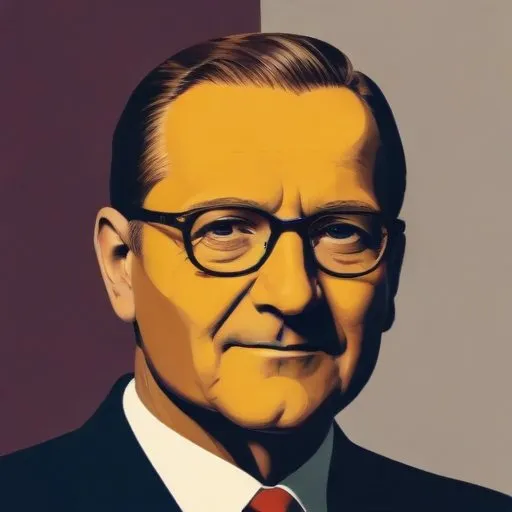
A German politician who served as the Minister of Justice in East Germany during the 1960s and 1970s, known for his role in shaping the country's legal system.
Hans Schuberth is renowned for being the first Federal Minister for Post and Telecommunications in Konrad Adenauer's first cabinet, serving from 1949 to 1953. During this period, he played a pivotal role in rebuilding Germany's post-war infrastructure, particularly in the telecommunications sector.
Schuberth was born on April 5, 1897, in Schwabach, Germany. After completing his graduation in 1914, he participated in World War I as a soldier, where he suffered serious injuries, resulting in the amputation of his leg. This experience had a profound impact on his life, shaping his perspective on the importance of reconstruction and nation-building.
Despite these challenges, Schuberth persevered, interning at a machines factory in Dortmund from 1915 to 1916. He then pursued his studies in mechanical engineering at the Technical University Munich, graduating in 1920 as a graduate engineer. During his studies, he became a member of the Catholic Student Association KDSt.V. Rheno-Franconia in Munich, an experience that fostered his sense of community and social responsibility.
Schuberth's contributions to post-war Germany's reconstruction were monumental. He played a crucial role in rebuilding the country's infrastructure, particularly in the telecommunications sector. His leadership and vision helped lay the foundation for Germany's economic miracle in the post-war era.
His commitment to public service and nation-building is a testament to his character and dedication. Schuberth's legacy serves as an inspiration to future generations, highlighting the importance of perseverance, hard work, and public service.
Hans Schuberth passed away on September 2, 1976, in Munich, leaving behind a legacy of public service and reconstruction. His personal life was marked by his strong sense of community and social responsibility, reflected in his involvement with the Catholic Student Association and his commitment to rebuilding Germany.
72 Years Old
The first female Chancellor of Germany, serving for 16 years, known for her leadership during the European sovereign-debt crisis and her role in shaping the European Union's policy. She's a highly influential figure in modern politics.
82 Years Old
The 7th Chancellor of Germany, a lawyer-turned-politician, led the country from 1998 to 2005, implementing significant economic and social reforms. He's known for his efforts to modernize Germany and strengthen the European Union.
85 Years Old
A German lawyer and politician who served as Minister President of Bavaria, known for his conservative policies and efforts to strengthen regional autonomy. He played a key role in shaping Bavaria's economy and politics.
