


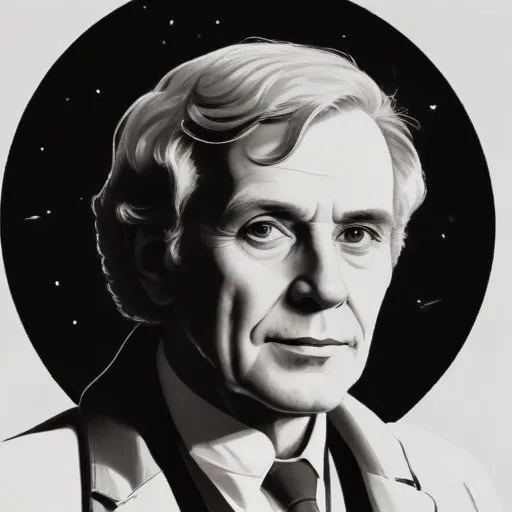
Developed innovative spectrographic instruments to study the Sun's magnetic field and discovered the Sun's magnetic field, making significant contributions to our understanding of the Sun's behavior.
Harold Delos Babcock, an American astronomer, made groundbreaking contributions to the field of solar spectroscopy, leaving an indelible mark on our understanding of the Sun's magnetic fields. He is renowned for being the first scientist to precisely map the distribution of magnetic fields over the Sun's surface, a feat that would change the course of astronomy forever.
Born on January 24, 1882, in Edgerton, Wisconsin, Babcock was of English and German ancestry. He showed an early interest in science and completed his high school education in Los Angeles before being accepted into the University of California, Berkeley in 1901.
In 1907, Babcock joined the Mount Wilson Observatory, where he would spend the next four decades of his career. During this period, he worked tirelessly to develop new techniques and instruments for solar spectroscopy. His most notable work involved the creation of a spectroheliograph, an instrument that enabled him to study the Sun's magnetic fields in unprecedented detail.
Babcock's collaboration with his son, Horace W. Babcock, led to several significant discoveries, including the observation of magnetic fields on the Sun's surface. Their work laid the foundation for modern solar physics and paved the way for future research in the field.
In recognition of his outstanding contributions to astronomy, Babcock was awarded the prestigious Bruce Medal in 1953. This esteemed honor is bestowed upon scientists who have made significant contributions to the field of astronomy.
The craters on the Moon and asteroid 3167 Babcock are named in his honor, a testament to his enduring legacy in the scientific community. Babcock's work continues to inspire astronomers and physicists today, and his pioneering spirit has left an indelible mark on our understanding of the universe.
Despite his many achievements, Babcock remained humble and dedicated to his work. He passed away on April 8, 1968, at the age of 86, leaving behind a legacy that continues to inspire future generations of scientists.
"The universe is not only stranger than we think, it is stranger than we can think." - Harold D. Babcock
Harold D. Babcock's remarkable career serves as a testament to the power of human curiosity and dedication. His groundbreaking work in solar spectroscopy has left a lasting impact on our understanding of the universe, and his legacy continues to inspire scientists and researchers today.
Born in 1889
Discovered galaxies beyond our own Milky Way, revolutionizing our understanding of the universe's scale and expansion. Pioneered observational cosmology, providing evidence for the Big Bang theory.
Born in 1868
Founded the Mount Wilson Observatory, pioneered the field of astrophysics, and developed innovative telescopes, making groundbreaking discoveries about the sun and stars.
Born in 1877
Developed the Hertzsprung-Russell diagram, a fundamental tool in astronomy that relates stars' brightness to their surface temperature. This diagram is still widely used today to understand the life cycles of stars.
Born in 1882
A pioneer in astrophysics, he formulated the Eddington limit, a crucial concept in understanding stars, and was a key figure in popularizing Einstein's theory of relativity. His work bridged the gap between theory and observation in astronomy.
Born in 1885
Measured the galaxy's size and mapped the Milky Way's structure, revolutionizing our understanding of the universe.
Born in 1900
Pioneering astronomer who discovered that stars are primarily composed of hydrogen and helium, revolutionizing our understanding of the universe. Her groundbreaking work paved the way for future generations of astronomers.
Born in 1910
A renowned scientist who pioneered our understanding of black holes and the behavior of stars, earning a Nobel Prize in Physics in 1983.
97 Years Old
A renowned Bollywood actor and producer, known for his iconic roles in classic Hindi films, earning him the title "Jubilee Kumar" for his consecutive box-office successes.
