


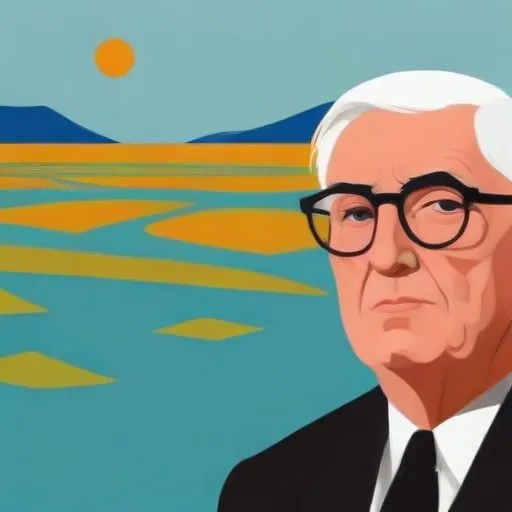
Visionary landscape artist creating dreamlike, symbolic, and fantastical scenes that blend reality and imagination. Known for pushing boundaries of traditional landscape art with bold colors and abstract forms.
Harold Hitchcock, born Raymond Hitchcock in 1914, was an English visionary landscape artist renowned for his intricately detailed and luminescent depictions of a romantic, mythological world. His work, characterized by its dreamlike quality and suffused with light, has been likened to the 17th-century painter Claude Lorraine.
Born in Camden Town, London, Hitchcock was raised in a family of artists, descended from the celebrated animal artist George Stubbs on his mother's side. It was during his childhood, while living with his grandparents in the Essex village of Thundersley, that Hitchcock experienced an ecstatic episode that sparked his passion for painting.
By the age of 16, Hitchcock's talent had already garnered attention from prominent figures, including Dame Laura Knight, who hailed him as a child prodigy. This early recognition led to commercial art opportunities, which he pursued until the outbreak of World War II.
As a conscientious objector, Hitchcock volunteered for bomb disposal work in the Non-Combatant Corps during the war. It was during this time that he met Margaret Torrie, a influential figure in the London art scene, who introduced him to the spiritual movement Subud. This encounter had a profound impact on Hitchcock's life and art, influencing his inner world and creative vision.
After the war, Hitchcock's art career flourished, with successful exhibitions and sales at the Hampstead open-air exhibition. In 1964, he dedicated himself full-time to his art, which led to his work being discovered by prominent patrons, including the 12th Duke of Bedford, who showcased his art at Woburn Abbey.
Hitchcock's art gained widespread recognition, with exhibitions in major London galleries and a growing market for his work in the US. Art establishment figures, such as Kenneth Clark and Sir Roy Strong, praised his work, and in 1984, he was honored with a retrospective exhibition at the RSA gallery in London.
Hitchcock's art is characterized by its imaginative and detailed depictions of an idealized world, where beauty and light reign supreme. His work often features mythological and fantastical elements, creating a sense of enchantment and wonder.
Harold Hitchcock's art has left an indelible mark on the world of visionary art, inspiring generations of artists and art enthusiasts alike. His legacy continues to inspire, with his work remaining a testament to the power of imagination and the human spirit.
Born in 1776
A Romantic-era painter celebrated for capturing the essence of the English countryside through serene, naturalistic landscapes, often featuring skies and clouds.
Born in 1727
A prominent 18th-century painter of landscapes and portraits, capturing the essence of British aristocracy and gentry with elegance and refinement.
Born in 1802
A Romantic-era painter celebrated for his vivid, expressive, and often turbulent seascapes and landscapes, which captivated the art world with their sense of drama and movement.
Born in 1793
A Romantic-era painter celebrated for dramatic, emotive landscapes and seascapes that evoke a sense of the sublime and the power of nature. His works often featured turbulent skies, rocky coastlines, and mythological themes.
Born in 1783
A Romantic-era artist capturing the beauty of the English countryside through serene and detailed landscapes, often featuring tranquil skies and rustic scenery.
Born in 1784
A Romantic-era landscape painter, celebrated for his dreamy, atmospheric watercolors of the English countryside. His works evoke a sense of serenity and nostalgia.
79 Years Old
A science fiction author who wrote novels and short stories that often explored themes of humanity, identity, and technology, known for his Eight Worlds series and novel "Titan".
