


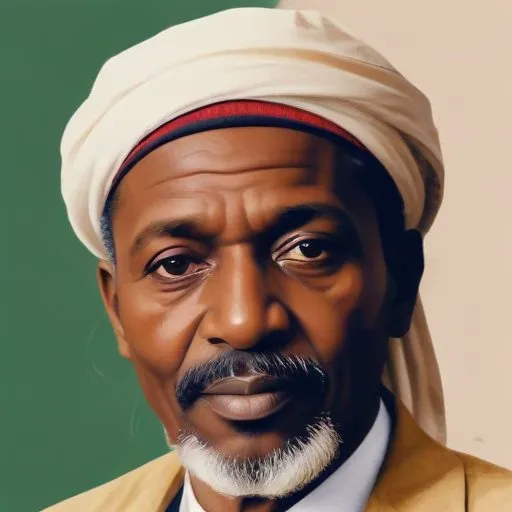
A prominent Islamist thinker and former Sudanese leader who played a key role in shaping the country's Islamic law and politics. He's known for his controversial views on Islam and democracy.
Hassan AlTurabi is known for being one of the most influential and controversial Islamic scholars of the 20th century. He was a Sudanese politician, lawyer, and Islamist thinker who played a significant role in shaping the modern Islamic movement in Sudan and beyond.
AlTurabi was born in 1932 in Kassala, eastern Sudan, to a family of intellectuals and Islamic scholars. He received his early education in Sudan before moving to Egypt to pursue higher studies in Islamic law and philosophy. He later earned a Ph.D. in law from the University of Sorbonne in Paris, where he was influenced by the ideas of European philosophers such as Jean-Paul Sartre and Martin Heidegger.
AlTurabi's political career began in the 1960s, when he founded the Islamic Charter Front, a political party that aimed to establish an Islamic state in Sudan. He was imprisoned several times for his political activism, but continued to advocate for the implementation of Sharia law in Sudan. In 1989, he became the leader of the National Islamic Front, which later became the dominant party in Sudan's government.
AlTurabi's philosophical contributions lie in his attempt to reconcile Islamic values with modernity and democracy. He argued that Islam is compatible with democracy and that Muslims can participate in the democratic process while remaining true to their faith. He also advocated for women's rights and education, and believed that Islam should be adapted to suit the needs of modern society.
AlTurabi's views on Islam and democracy have been controversial, with some accusing him of promoting a moderate form of Islam that is incompatible with traditional Islamic teachings. He has also been criticized for his support of the Sudanese government's policies, which have been accused of human rights abuses and persecution of minority groups.
AlTurabi's influence on modern society extends beyond Sudan's borders. His ideas on Islamic democracy have inspired Islamist movements across the Middle East and Africa, and his writings have been translated into several languages. He has also been a vocal critic of Western imperialism and has called for greater engagement between Islamic and Western civilizations.
AlTurabi's major works include "The Islamization of Knowledge," "The Call of the Minaret," and "The Qu'ran and the Challenge of Modernity." His writings have been widely read and debated, and have influenced a generation of Islamic scholars and thinkers.
Hassan AlTurabi's legacy is complex and contested. While he is revered by many as a pioneering Islamic scholar and thinker, others see him as a controversial figure who has promoted a watered-down version of Islam. Nevertheless, his influence on modern Islamic thought and politics cannot be denied, and his ideas continue to shape the discourse on Islam and democracy in the Middle East and beyond.
"Islam is not a religion, it's a way of life."
"Democracy is not a Western concept, it's an Islamic concept."
"The Qu'ran is not a book of laws, it's a book of guidance."
By examining AlTurabi's life and ideas, we can gain a deeper understanding of the complexities of modern Islamic thought and the challenges of reconciling tradition with modernity. Despite the controversies surrounding him, AlTurabi remains an important figure in the history of Islamic thought, and his legacy continues to inspire and provoke scholars and thinkers around the world.
89 Years Old
The authoritarian leader who ruled Iraq with an iron fist, notorious for his brutal suppression of dissent and invasion of neighboring countries.
Born in 1918
Led Egypt through a period of rapid modernization and nationalism, becoming a symbol of Arab unity and resistance to Western influence. He nationalized the Suez Canal and implemented socialist reforms.
98 Years Old
The authoritarian leader who ruled Egypt for nearly three decades, suppressing opposition and maintaining a tight grip on power, while also maintaining a delicate balance of power in the Middle East. He's infamous for his regime's human rights abuses and corruption.
