


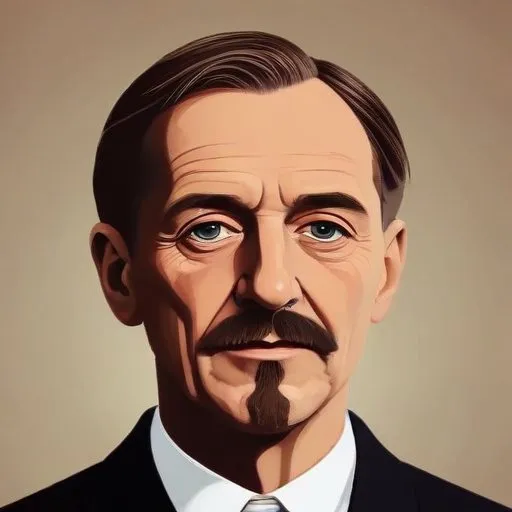
A prominent literary figure of the early 20th century, known for his socially critical and psychologically nuanced novels that explored the darker aspects of German society. His works often targeted the bourgeoisie and the rise of fascism.
Heinrich Mann, a towering figure in German literature, is revered for his scathing sociopolitical novels that exposed the dark underbelly of imperialism, militarism, and fascism. As a fiercely anti-war and defeatist writer, Mann's works resonated with the Left Wing circles during the Weimar Republic, earning him both acclaim and controversy.
Born on March 27, 1871, in Lbeck, Germany, Heinrich Mann was the eldest child of Senator Thomas Johann Heinrich Mann, a grain merchant and finance minister of the Free City of Lbeck. His family, an affluent Hanseatic dynasty, had a profound impact on his life and writing. His younger brother, Thomas Mann, would later become a celebrated author in his own right, sparking a lifelong rivalry between the two.
After completing his education, Mann embarked on a career as a freier Schriftsteller (free writer), eventually moving to Munich where he began to make a name for himself. His essay on mile Zola and the novel Der Untertan, published between 1912 and 1918, cemented his reputation as a bold and incisive writer. The latter work, in particular, satirized Imperial German society, sparking both admiration and outrage.
As the Nazi party rose to power in 1933, Mann's outspoken criticism of fascism forced him into exile. He fled Germany, leaving behind his presidency of the fine poetry division of the Prussian Academy of Arts, which he had held since 1930. This tumultuous period would later inform some of his most powerful writing.
In 1914, Mann married Maria Mimi Kanova, a Czech actress. The couple divorced in 1930, but tragedy struck when Mimi died in 1943 due to the harsh conditions of her five-year detention in the Theresienstadt concentration camp.
Mann's literary contributions are immense, with notable works including Der Untertan, Die grosse Sache, and Konzert bei Verichtungen. His writing not only reflected the turbulent times in which he lived but also confronted the darker aspects of human nature. As a result, Mann's oeuvre remains a powerful testament to the enduring power of literature as a tool for social critique and change.
At the heart of Mann's writing lies a deep-seated commitment to humanism, democracy, and individual freedom. He believed that literature should serve as a mirror to society, exposing its flaws and injustices. This conviction led him to vocally oppose the rise of fascism and militarism, even in the face of personal danger.
Heinrich Mann's unflinching commitment to speaking truth to power has inspired generations of writers, activists, and thinkers. His work continues to resonate with contemporary audiences, offering a powerful reminder of the importance of critical thinking, moral courage, and artistic expression in the face of oppression.
Mann's life and work are inextricably linked to the tumultuous decades that shaped modern Germany. His writing serves as a testament to the power of literature to challenge, provoke, and inspire. As a result, his legacy continues to influence contemporary debates on politics, art, and society, ensuring his place as one of the most important German writers of the 20th century.
"The writer's task is to speak the truth, and to speak it clearly, without regard to the consequences."
"Art is the only way to run away without leaving home."
A life marked by courage, conviction, and an unwavering commitment to his art, Heinrich Mann remains an enduring figure in the pantheon of German literature, his works continuing to inspire and provoke readers to this day.
Born in 1875
A renowned literary mastermind, celebrated for crafting complex, psychologically rich novels that probed the human condition, often blending philosophy and art.
Born in 1855
A renowned German author and playwright, he is best known for his romantic and historical novels, particularly those set in the Bavarian Alps, which have been adapted into films and stage productions. His works often explored themes of love, nature, and social class.
Born in 1862
A German literary giant, renowned for his naturalistic and socially conscious works that explored the human condition, earning him the Nobel Prize in Literature in 1912.
Born in 1864
A pioneering playwright and actor who shocked audiences with his provocative and daring works, exploring themes of sexuality, morality, and social norms.
Born in 1862
Austrian author and playwright who explored the human psyche through his works, often focusing on themes of love, relationships, and the bourgeoisie. His plays and novels offered a glimpse into the lives of Viennese high society during the early 20th century.
Born in 1878
A Swiss literary mastermind, known for his poignant and introspective writings that explored the human condition, often blurring the lines between reality and fantasy.
Born in 1877
A renowned poet, novelist, and painter, celebrated for his thought-provoking and introspective works that explore the human condition, spirituality, and the search for meaning. His writings often blended elements of psychology, philosophy, and mysticism.
Born in 1898
A German-Swiss soldier and author, best known for writing the classic novel "All Quiet on the Western Front", a powerful anti-war tale that vividly depicts the horrors of World War I.
