


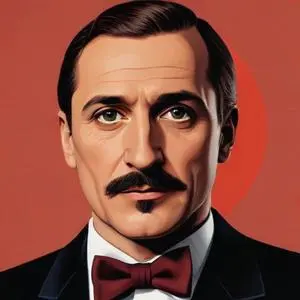
A pioneering playwright and actor who shocked audiences with his provocative and daring works, exploring themes of sexuality, morality, and social norms.
Frank Wedekind, a German playwright, is renowned for his bold and controversial works that criticized the bourgeoisie and their stifling societal norms, paving the way for the Expressionist and Epic Theatre movements. His most notable works, the Lulu cycle and Spring Awakening, continue to inspire and shock audiences to this day.
Born on July 24, 1864, in Hanover, Germany, Wedekind's life was marked by a sense of restlessness and nonconformity. His mother, a Swiss national, conceived him in San Francisco, and his father, a German, owned a castle in Switzerland, where Wedekind spent his early years. This unconventional upbringing instilled in him a disdain for the conventions of the bourgeoisie.
Before becoming a playwright, Wedekind worked in business, advertising, and even the circus. However, it was his experiences as an actor and singer that truly ignited his passion for the stage. In 1901, he co-founded the satirical cabaret Die elf Scharfrichter, where he became the principal star, earning widespread acclaim for his biting satire.
The Lulu cycle, comprising Erdgeist (1895) and Die Büchse der Pandora (1904), is Wedekind's most famous work. The plays follow the life of a young, enigmatic dancer-adventuress, Lulu, as she navigates the treacherous waters of bourgeois society. Through Lulu's story, Wedekind excoriates the hypocrisy and shallowness of the upper class, exposing the darker aspects of human nature.
Wedekind's earlier play, Frühlings Erwachen (1891), was largely forgotten until its Broadway adaptation in 2006. This play's exploration of teenage angst, sexuality, and mortality resonated with modern audiences, cementing Wedekind's status as a visionary playwright.
Wedekind's influence on modern theatre is undeniable. His work paved the way for Expressionist playwrights like Bertolt Brecht and Ernst Toller, as well as inspiring generations of writers, including Kurt Tucholsky and Erich Kästner. His legacy continues to inspire artists, challenging them to push the boundaries of social commentary and artistic expression.
"The bourgeoisie can be accused of many things, but not of being ignorant of the fact that it is bourgeois."
"The theatre is the only place where you can be yourself, and yet be someone else at the same time."
Wedekind's plays continue to resonate with modern audiences, inspiring adaptations and reinterpretations. His critique of bourgeois values and exploration of human nature's darker aspects remain relevant in today's society. As a writer, he embodied the spirit of rebellion and nonconformity, inspiring generations of artists to challenge the status quo.
Born in 1790
Austrian actor and playwright who wrote and performed in popular folk plays, often incorporating magic and fantasy elements, and was a key figure in Vienna's theatrical scene. He is particularly known for his humorous and satirical works that poked fun at social issues of his time.
Born in 1801
Austrian actor and playwright who wrote satirical plays that critiqued social issues, known for his witty dialogue and clever characterizations.
Born in 1878
A German literary figure who wrote provocative plays and poetry that critiqued societal norms and authority, inspiring anarchist and anti-war movements.
Born in 1874
Austrian satirist and writer who critiqued the hypocrisy of modern life through his witty writings and biting social commentary. He's most famous for his magazine Die Fackel, which he wrote and published single-handedly for over 30 years.
Born in 1862
Austrian author and playwright who explored the human psyche through his works, often focusing on themes of love, relationships, and the bourgeoisie. His plays and novels offered a glimpse into the lives of Viennese high society during the early 20th century.
Born in 1874
Austrian literary giant behind iconic works like "Der Rosenkavalier" and "Electra", known for poetic and philosophical explorations of human identity and morality.
Born in 1890
Austrian-Bohemian author, poet, and playwright known for his novels and plays that often explored themes of identity, morality, and social justice, particularly in the context of World War I and the Jewish experience.
Born in 1881
A celebrated writer of psychological novels and biographies that probed the human condition, known for his vivid storytelling and insightful portrayals of historical figures.
