


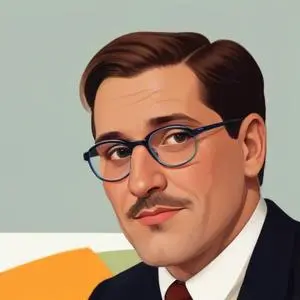
A German-Swedish journalist and author who wrote satirical and humorous articles, novels, and poems, critiquing politics and society during the Weimar Republic era.
Kurt Tucholsky, a German journalist, satirist, and writer, is renowned for his acerbic critiques of authority, aristocracy, and the rising tide of Nazism in the early 20th century. Through his prolific writings, which span over 2,000 essays, manifestos, poems, critiques, aphorisms, and stories, Tucholsky established himself as a fearless and passionate advocate for democracy, pacifism, and social justice.
Born on January 9, 1890, in Berlin, Germany, to a German Jewish family, Tucholsky's early life was marked by a strong sense of social responsibility and a passion for literature. He studied law and philosophy at the University of Berlin, where he developed his critical thinking and writing skills.
Tucholsky's journalistic career began in 1907, when he started writing for the Berliner Tageblatt. He later became a coeditor of the weekly magazine Die Weltbühne, a platform that allowed him to express his political views and satirical writings. To avoid censorship and persecution, Tucholsky employed several pseudonyms, including Kaspar Hauser, Peter Panter, Theobald Tiger, and Ignaz Wrobel.
A self-proclaimed left-wing democrat and pacifist, Tucholsky's writings were characterized by a strong sense of social critique and a commitment to exposing the injustices of the time. He was a fierce opponent of militarism, nationalism, and the rising Nazi movement, which he saw as a threat to democracy and human rights.
Tucholsky's literary works, which include Rheinsberg: A Storybook for Lovers (1912) and Castle Gripsholm: A Summer Story (1931), were widely acclaimed for their wit, satire, and poignant critique of German society. His works were translated into English, making him one of the most prominent German writers of his time.
In May 1933, the Nazi regime banned Tucholsky's works, labeling them as "un-German." The burning of his books and the revocation of his German citizenship were a testament to the power of his critiques and the fear they instilled in those who sought to maintain the status quo.
Tucholsky's unwavering commitment to democracy, pacifism, and social justice has inspired generations of writers, activists, and thinkers. He remains one of the most important and influential writers of the 20th century, a testament to the power of satire and critique in the face of oppression.
"The bourgeoisie is threatened by the proletariat, but also by itself."
"In Germany, you can turn any word into a insult by adding the prefix 'public' to it."
Tucholsky's quotes and writings continue to inspire and challenge us to this day, serving as a powerful reminder of the importance of critical thinking and social responsibility.
Born in 1898
A pioneering playwright and poet who revolutionized theater with his epic style, blending politics and art to create socially conscious works that continue to influence contemporary drama.
Born in 1898
A German-Swiss soldier and author, best known for writing the classic novel "All Quiet on the Western Front", a powerful anti-war tale that vividly depicts the horrors of World War I.
Born in 1899
A celebrated German writer and poet, best known for his humorous and satirical children's books, such as "Emil and the Detectives" and "Lottie and Lisa", which have been beloved by generations of readers.
Born in 1871
A prominent literary figure of the early 20th century, known for his socially critical and psychologically nuanced novels that explored the darker aspects of German society. His works often targeted the bourgeoisie and the rise of fascism.
Born in 1875
A renowned literary mastermind, celebrated for crafting complex, psychologically rich novels that probed the human condition, often blending philosophy and art.
Born in 1884
A prominent German literary figure of the 20th century, known for his historical novels and plays that often explored the human condition, morality, and social justice. His works were widely read and adapted into films and stage productions.
Born in 1887
A German writer and pacifist who explored the human cost of war and social justice in his novels, particularly in his acclaimed work "The Case of Sergeant Grischa".
Born in 1878
A Polish-German physician and author who wrote influential novels that explored the human condition, blending psychology, philosophy, and social commentary. His works are considered precursors to magical realism.
