


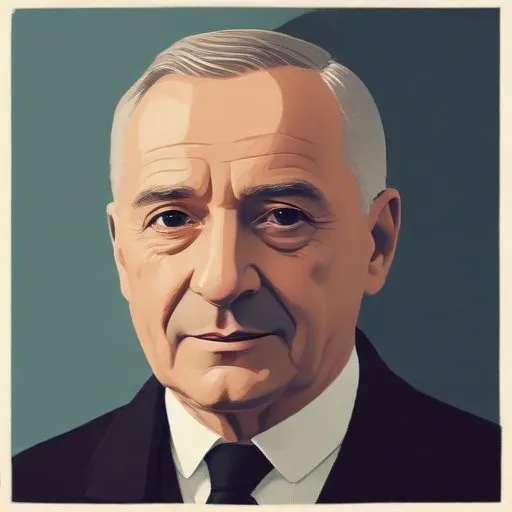
A Polish-German physician and author who wrote influential novels that explored the human condition, blending psychology, philosophy, and social commentary. His works are considered precursors to magical realism.
Alfred Dblin is renowned for his magnum opus, Berlin Alexanderplatz, a novel that epitomizes the essence of German literary modernism. Published in 1929, this groundbreaking work catapulted Dblin to literary stardom, earning him a reputation as one of the most important figures of 20th-century German literature.
Born on August 10, 1878, in Stettin, Germany (now Szczecin, Poland), Dblin grew up in a family of assimilated Jews. After his father abandoned them, Dblin moved to Berlin with his mother and siblings at the tender age of ten. This relocation would have a profound impact on his life, as Berlin would remain his home for nearly 45 years and become the inspiration for many of his literary works.
Dblin's literary journey began with the publication of his first novel, Die drei Sprnge des Wang-lun (The Three Leaps of Wang-lun), in 1915. This marked the beginning of a prolific career that would span over half a century and encompass a diverse range of literary movements and styles. His oeuvre includes:
His complete works, republished by Deutscher Taschenbuch Verlag and Fischer Verlag, span an impressive thirty volumes.
With the rise of the Nazi dictatorship, Dblin was forced into exile in 1933. He spent the next seven years in France, before fleeing to the United States in 1940. During his time in Los Angeles, Dblin converted to Catholicism. After the war, he returned to West Germany, where he continued to write until his passing on June 26, 1957.
Dblin's contributions to German literary modernism are immeasurable. His works not only reflect the tumultuous era in which he lived but also offer a unique perspective on the human condition. His influence can be seen in the works of many contemporary authors, and his legacy continues to inspire new generations of writers and readers alike.
"The novel is a mirror, and the mirror shows us our face."
Through his writing, Dblin continues to reflect the complexities of human nature, illuminating the complexities of our shared existence.
Born in 1882
A pioneering modernist writer, known for experimental novels and short stories that explore the human experience, particularly in Dublin, Ireland. His works are celebrated for their complex, lyrical prose and innovative narrative structures.
Born in 1883
A writer of surreal, psychologically complex fiction that explores the human condition, often featuring isolated protagonists in absurd, nightmarish scenarios.
Born in 1871
A French literary mastermind who penned the monumental, introspective novel "In Search of Lost Time", exploring the human experience through vivid, nostalgic storytelling.
Born in 1886
Austrian-American author and poet, known for his novels that explored the decay of values in modern society, particularly in his masterpiece "The Death of Virgil".
Born in 1875
A renowned literary mastermind, celebrated for crafting complex, psychologically rich novels that probed the human condition, often blending philosophy and art.
Born in 1871
A prominent literary figure of the early 20th century, known for his socially critical and psychologically nuanced novels that explored the darker aspects of German society. His works often targeted the bourgeoisie and the rise of fascism.
Born in 1890
A German-Swedish journalist and author who wrote satirical and humorous articles, novels, and poems, critiquing politics and society during the Weimar Republic era.
