


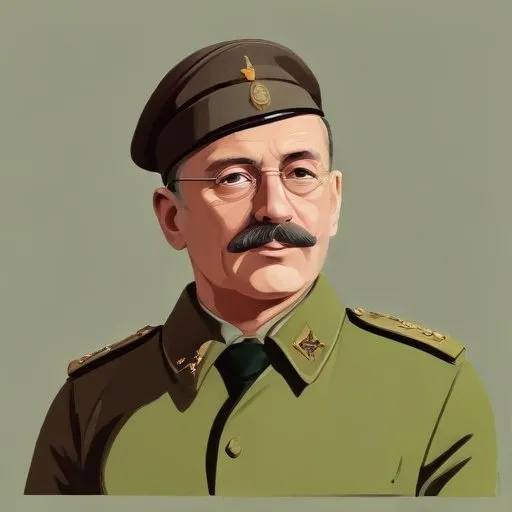
A German chemist and soldier who developed the first practical method for producing polyurethane foam, revolutionizing the plastics industry. His work led to numerous applications in various fields, including construction, automotive, and more.
Helmut Kallmeyer, a German chemist, is infamous for his involvement in the Action T4 program, a Nazi regime initiative that aimed to murder people with disabilities. As a consultant in Adolf Hitler's Chancellery and later at the Technical Institute for the Detection of Crime, Kallmeyer's expertise in gasification methods played a pivotal role in the atrocities committed during this period.
Born on October 8, 1910, in Hamburg, Germany, Helmut Kallmeyer was the son of a senior government surveyor. He passed his Abitur in 1929 and went on to study chemistry at various universities. In 1939, he completed his studies at the Technical University of Berlin and received his doctorate the following year.
Drafted into the Kriegsmarine in 1940, Kallmeyer served until September 1941, when he was discharged for special home front duty. During this time, he joined the Sturmabteilung (SA), the Nazi Party's early paramilitary wing, claiming it was an automatic transfer from his German sailing club membership. In 1940, he married Gertrud Fröse, who had worked at the Grafeneck Euthanasia Centre, and Viktor Brack, a key figure in Action T4, was among their wedding guests.
Recruited by Brack, Kallmeyer became involved in Action T4, using his chemical expertise to facilitate the killings. Alongside August Becker and Albert Widmann, Kallmeyer was one of the three chemists integral to the program's success. Due to the lack of documentation, the full extent of Kallmeyer's involvement remains unclear, but his contributions were undoubtedly significant.
After the war, Kallmeyer's actions went largely unnoticed, and he avoided prosecution. He passed away on September 27, 2006, leaving behind a dark legacy as a willing participant in one of humanity's most heinous acts. Today, his name serves as a cautionary tale about the dangers of unchecked ambition and the dangers of silence in the face of evil.
Kallmeyer's involvement in Action T4 raises questions about the moral and ethical implications of scientific expertise being used to further inhumane agendas. His actions serve as a stark reminder of the importance of scientific responsibility and the need for professionals to uphold ethical standards.
∎ ∎ ∎
∎ ∎ ∎
Born in 1868
Developed a process to synthesize ammonia, revolutionizing agriculture and warfare, and was awarded the Nobel Prize in Chemistry in 1918.
Born in 1879
A pioneering nuclear chemist who discovered nuclear fission, a process that releases massive energy from atomic nuclei, and was awarded the Nobel Prize in Chemistry in 1944.
Born in 1878
Pioneering physicist who made groundbreaking contributions to nuclear physics, including the discovery of nuclear fission, and was the first woman to become a full professor of physics in Germany.
Born in 1901
A pioneer in quantum mechanics, he formulated the uncertainty principle, which revolutionized our understanding of the atomic world. His groundbreaking work reshaped modern physics.
Born in 1885
A pioneer in quantum mechanics, he introduced the concept of wave-particle duality, revolutionizing our understanding of atomic structure. His philosophical approach to science also explored the nature of reality and human understanding.
Born in 1879
A brilliant physicist who developed the theory of relativity and is considered one of the most influential scientists of the 20th century, known for his groundbreaking work in physics and mathematics.
Born in 1867
A pioneering scientist who pioneered radioactivity research, discovering elements polonium and radium, and paving the way for breakthroughs in medicine and energy.
