


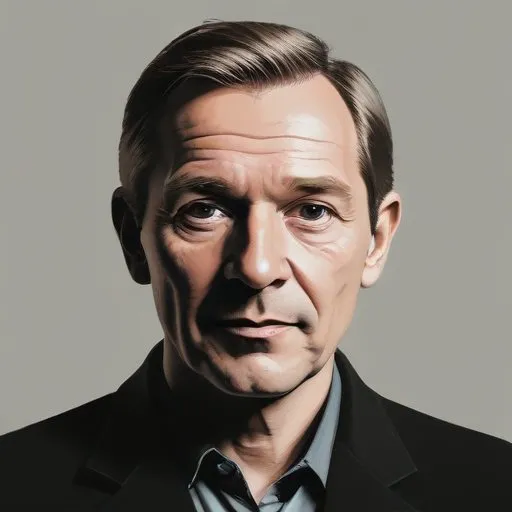
A Dutch-South African painter and author who explored the complexities of apartheid through his vibrant artwork and written narratives. His creative expressions continue to spark conversations about social justice and humanity.
Henk van Woerden was a renowned Dutch painter and writer, best known for his thought-provoking literary works that delved into the complexities of South Africa's tumultuous history, particularly during the Apartheid era. Through his writing, Van Woerden shed light on the lives of those who lived through those turbulent times, earning him critical acclaim and numerous awards.
Born on December 6, 1947, in Leiden, Netherlands, Van Woerden spent his early years in Cape Town, South Africa, where his family emigrated in 1956. He matriculated from the University of Cape Town's Fine Arts faculty in 1964, but abandoned his studies three years later to travel extensively throughout Europe, eventually settling in Amsterdam.
Van Woerden's artistic career began in the 1970s, primarily as a painter based in Amsterdam. His work earned him the prestigious Royal Award for Painting in 1980, and he went on to represent the Netherlands at various international exhibitions. However, it was his shift to writing in the 1980s that cemented his legacy as a masterful storyteller.
Van Woerden's writing career was marked by a trilogy of books that explored South Africa's complex history. His debut novel, Moenie kyk nie (Don't Look), was published in 1993, followed by Tikoes in 1996. The trilogy was completed with Een mond vol Glas (A Mouthful of Glass) in 1998, which received critical acclaim from renowned South African authors, including Breyten Breytenbach, J.M. Coetzee, and Andr Brink.
Een mond vol Glas is a biography of Dimitri Tsafendas, who assassinated South African President Dr. Hendrik Verwoerd in 1966. The book won the 2001 Alan Paton Award and was later translated into English as A Mouthful of Glass or The Assassin: A Story of Race and Rage in the Land of Apartheid.
Van Woerden's subsequent works include Notities van een luchtfietser (Notes from an Air Cyclist) in 2002, which explored the theme of travel in both the physical and mental realms, and Ultramarijn (Ultramarine) in 2005, which would be his final work.
Henk van Woerden's body of work serves as a testament to his unwavering commitment to shedding light on South Africa's complex history. Through his writing, he created a window into the lives of those who lived through the Apartheid era, providing a deeper understanding of the human experience during those tumultuous times.
Van Woerden's passing on November 16, 2005, marked the loss of a remarkable talent, but his literary contributions continue to inspire and educate readers to this day.
86 Years Old
A South African-French poet and painter who explored themes of identity, politics, and human rights through his work, blending words and images to convey powerful messages.
Born in 1923
A South African writer and activist, known for her powerful novels and short stories that explored the complexities of apartheid and racial segregation. Her works often blurred the lines between politics and literature.
86 Years Old
A novelist, essayist, and linguist who explores the human condition through complex, introspective works, often focusing on South African politics and identity. He's known for his nuanced, thought-provoking writing style.
Born in 1918
A South African lawyer and politician who fought against apartheid, becoming the country's first black president and a symbol of racial reconciliation, earning a Nobel Peace Prize. He's a beacon of hope and freedom.
94 Years Old
A renowned playwright, director, and actor who explored the complexities of apartheid-era South Africa through his works, often blending drama and social commentary. His plays are celebrated for their poignant portrayal of human struggle and resilience.
