


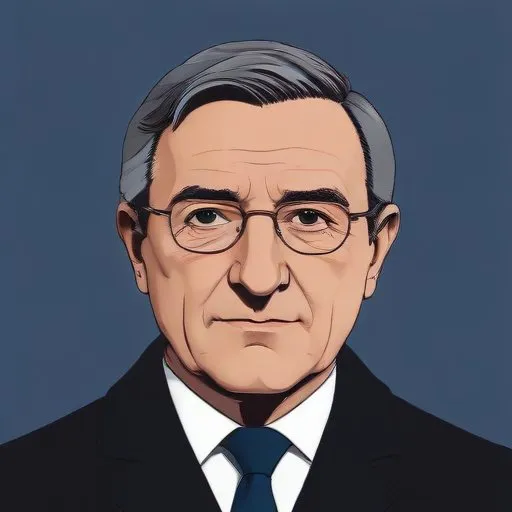
A French lawyer and politician who served as Prime Minister of France during the early 20th century, known for his role in shaping the country's political landscape. He played a key part in the separation of church and state in France.
If you ask any French historian about Henri Brisson, they'll tell you he's the man who served as Prime Minister of France not once, but twice – in 1885-1886 and again in 1898. But that's just the tip of the iceberg. Brisson was a champion of education, a fierce opponent of clericalism, and a key player in shaping France's Third Republic.
Born in Bourges, Cher, on July 31, 1835, Brisson followed in his father's footsteps to become an advocate. It wasn't long before he made his mark in politics, opposing the French Second Empire in its final days. When the empire fell, Brisson was appointed deputy mayor of Paris, a role that paved the way for his election to the National Assembly in 1871.
Brisson was a staunch advocate for compulsory primary education, believing that every French citizen deserved access to quality education. He also fought tirelessly against clericalism, pushing for the separation of church and state. This fight earned him some powerful enemies, but Brisson remained committed to his principles.
In the late 1800s, France was rocked by the Panama scandals, a series of corruption allegations that threatened to topple the government. Brisson played a crucial role in exposing the scandals, using his platform to demand accountability. His bravery earned him recognition as a potential presidential candidate, and he ran for the top job twice – in 1894 and 1895 – ultimately losing to Jean Casimir-Perier and Félix Faure.
In 1898, Brisson's commitment to justice and equality led to his reappointment as Prime Minister. His government faced a daunting challenge: the Dreyfus affair, a case of alleged treason that polarized the nation. Brisson's firm stance against anti-Semitism and his support for Captain Dreyfus earned him both admiration and criticism. Despite his best efforts, Brisson's government fell in October 1898, but his legacy lived on.
Henri Brisson's contributions to French politics and society cannot be overstated. He was a true champion of the people, fighting for education, secularism, and justice. His commitment to the principles of the French Revolution – liberty, equality, and fraternity – inspired generations of French politicians and citizens alike. Today, Brisson remains an important figure in French history, a testament to the power of conviction and principle in public life.
Henri Brisson may not be a household name, but his impact on French history is undeniable. As a statesman, educator, and champion of justice, he left an indelible mark on his nation. Today, his legacy serves as a reminder of the power of principle and conviction in public life.
Born in 1872
A French lawyer and politician who served as Prime Minister of France, known for his leadership during the Popular Front government and his role in shaping the country's social and economic policies.
Born in 1841
A French journalist, physician, and politician who served as Prime Minister of France during World War I, leading the country to victory and playing a key role in shaping the Treaty of Versailles. He's also known for his strong leadership and witty humor.
Born in 1840
A pioneering figure in naturalist literature, known for his influential novels that exposed social ills and championed reform, such as "Germinal" and "Nana".
Born in 1862
A French statesman who served as Prime Minister of France and was awarded the Nobel Peace Prize for his efforts to establish the European unity and collective security. He played a key role in shaping the League of Nations and promoting international cooperation.
Born in 1860
A French statesman who served as President of France during a tumultuous period, playing a crucial role in shaping the country's response to World War I. He's also known for his efforts to reform the French economy and stabilize the franc.
Born in 1863
A French mathematician and politician who served as Prime Minister of France, making significant contributions to mathematics, particularly in the field of differential equations. He's also known for his role in shaping France's early 20th-century politics.
