


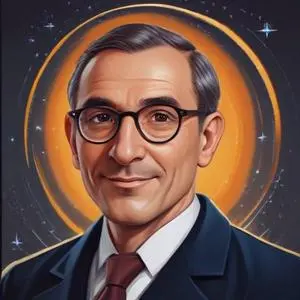
Discovered the element fluorine and developed an electric arc furnace, earning a Nobel Prize in Chemistry in 1906.
Henri Moissan, a French chemist and pharmacist, is renowned for his groundbreaking work in isolating fluorine from its compounds, earning him the prestigious 1906 Nobel Prize in Chemistry. This monumental discovery marked a significant milestone in the field of chemistry, solidifying Moissan's position as a pioneer in his field.
Born on September 28, 1852, in Paris, France, Moissan was the son of a minor officer of the eastern railway company, Francis Ferdinand Moissan, and a seamstress, Josphine Amraldine née Mitel. His mother was of Jewish descent, and his father was not. Moissan's early life was marked by relocation, moving to Meaux in 1864, where he attended local school and later became an apprentice clockmaker.
In 1870, Moissan and his family returned to Paris due to the war against Prussia. Despite facing challenges in receiving the necessary grades to attend university, Moissan persevered, enrolling at the Ecole Supérieure de Pharmacie de Paris in 1871. He began working as a trainee in pharmacy, later saving a person poisoned with arsenic, which ignited his passion for chemistry.
Moissan's academic career flourished under the guidance of prominent chemists Edmond Frémy and Pierre Paul Dehérain. He passed the baccalauréat in 1874 and qualified as a first-class pharmacist at the Ecole Supérieure de Pharmacie in 1879. Moissan received his doctoral degree in 1880 and rapidly climbed the ranks of the School of Pharmacy, becoming Assistant Lecturer, Senior Demonstrator, and finally Professor of Toxicology by 1886. He was appointed Chair of Inorganic Chemistry in 1899, succeeding Louis Joseph Troost as Professor of Inorganic Chemistry at the Sorbonne.
In 1886, Moissan successfully isolated fluorine, a feat that had eluded scientists for decades. This achievement earned him the 1906 Nobel Prize in Chemistry, recognizing his pioneering work in the field. Moissan's discovery revolutionized the understanding of chemistry, paving the way for significant advancements in the field.
Moissan's legacy extends beyond his Nobel Prize-winning discovery. He was one of the original members of the International Atomic Weights Committee, contributing significantly to the development of modern chemistry. His work has had a lasting impact on various fields, including medicine, agriculture, and industry.
Throughout his career, Moissan was driven by a passion for discovery and a commitment to advancing scientific knowledge. His remarkable achievements serve as a testament to his dedication and perseverance, inspiring future generations of scientists to strive for excellence.
Moissan's work embodies the principles of perseverance, curiosity, and dedication. He demonstrated a relentless pursuit of knowledge, pushing the boundaries of human understanding. His legacy serves as a testament to the power of human ingenuity and the importance of scientific inquiry.
Born in 1867
A pioneering scientist who pioneered radioactivity research, discovering elements polonium and radium, and paving the way for breakthroughs in medicine and energy.
Born in 1859
A pioneer in radioactivity research, discovering elements like polonium and radium, and pioneering radioactive isolation techniques. Their groundbreaking work paved the way for advancements in medicine, energy, and materials science.
Born in 1743
Father of modern chemistry, discovered oxygen, and developed a systematic method of chemical nomenclature. He laid the foundation for modern chemistry and paved the way for future scientific discoveries.
Born in 1822
Developed vaccines for rabies and anthrax, and pioneered the germ theory of disease, revolutionizing our understanding of microbiology and disease prevention.
