


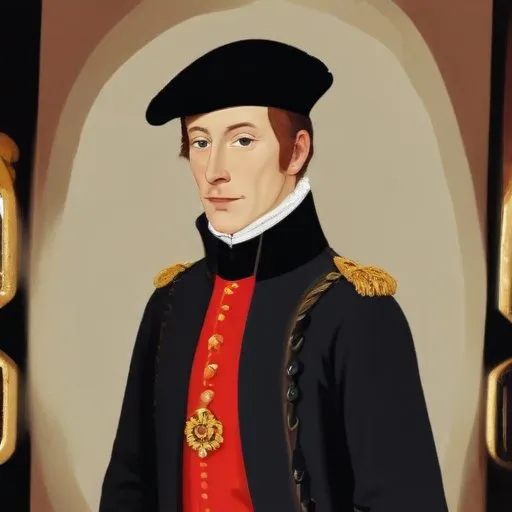
A prominent nobleman and military leader during the English Civil War, known for his role in the Second Bishops' War and his allegiance to the royalist cause.
Hailed as one of the wealthiest peers of the court of Elizabeth I, Henry Percy, 9th Earl of Northumberland, was a grandee known for his scientific and alchemical experiments, passion for cartography, and an extensive library that earned him the sobriquet "The Wizard Earl."
Born on April 27, 1564, at Tynemouth Castle in Northumberland, England, Henry Percy was the son of Henry Percy, 8th Earl of Northumberland, and Katherine Neville, daughter and coheiress of John Neville, 4th Baron Latimer and Lucy Somerset. His father's apparent suicide in the Tower of London in 1585 led to Henry's succession as the 9th Earl of Northumberland.
Henry Percy was a patron of the arts, employing notable artists such as Nicolas Hilliard, who painted his portrait in 1586 for 60 shillings. He also acquired a jewel called the Rainbow in 1598 for 21 shillings from John Spilman. His accounts reveal that he had an African servant, known as the Blackamore, who was brought to him in 1586 and was rewarded with new clothes and shoes.
Brought up as a Protestant, Henry Percy received instruction from the vicar of Egremont. This did not prevent suspicions in later life that he was a crypto-Catholic, particularly when he associated with Charles Paget.
Aside from his earldom in the north of England, Henry Percy owned estates in the south at Petworth House in Sussex and Syon House in Middlesex, acquired through his marriage to Lady Dorothy Devereux.
Under James I, Henry Percy was imprisoned in the Tower of London for several years due to suspicion of complicity in the Gunpowder Plot. Although eventually released, his reputation was tarnished, and he spent the remainder of his life attempting to clear his name.
Henry Percy, 9th Earl of Northumberland, died on November 5, 1632. His legacy as "The Wizard Earl" remains, a testament to his contributions to science, cartography, and the arts. His extensive library and alchemical experiments have inspired generations of scholars and researchers.
Despite the controversies surrounding his life, Henry Percy, 9th Earl of Northumberland, remains an intriguing figure in English history, remembered for his intellectual pursuits, artistic patronage, and extensive library.
Born in 1729
An 18th-century Irish bishop and poet, he's remembered for his influential collections of traditional Irish ballads, which helped preserve the country's cultural heritage.
Born in 1457
First Tudor king of England, who ended the Wars of the Roses and established a strong, centralized government, bringing stability and prosperity to the country.
Born in 1239
Conqueror of Wales and hammer of the Scots, he strengthened the English monarchy and established parliamentary representation.
Born in 1926
The monarch of the United Kingdom and its Commonwealth realms, serving as a unifying figurehead and symbol of national identity, while also carrying out various ceremonial and charitable duties.
Born in 1574
An English explorer and cartographer who mapped the New World and created innovative navigational tools, contributing significantly to the development of modern cartography.
Born in 1554
A Renaissance man who excelled in literature, politics, and warfare, leaving a lasting legacy in the world of poetry and chivalry.
