


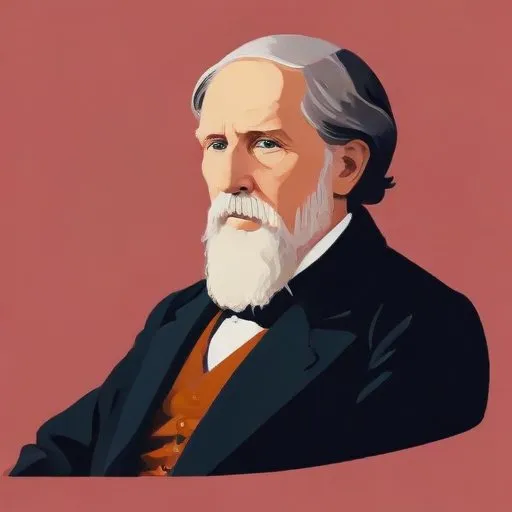
A pioneering utilitarian philosopher and economist who developed influential theories on ethics, morality, and welfare economics, shaping modern thought on these subjects.
Henry Sidgwick, one of the most influential philosophers of the 19th century, is best known for his groundbreaking work, The Methods of Ethics, a utilitarian treatise that has had a lasting impact on philosophical thought. As an economist, philosopher, and advocate for women's education, Sidgwick's contributions have reshaped the landscape of moral philosophy, economics, and social reform.
Born on May 31, 1838, in Skipton, Yorkshire, Sidgwick was the son of Reverend W. Sidgwick, the headmaster of the local grammar school. His mother, Mary Sidgwick (née Crofts), played a significant role in nurturing his intellectual curiosity. Sidgwick's academic journey took him to Rugby, where his cousin, Edward White Benson, later Archbishop of Canterbury, was a master. He then attended Trinity College, Cambridge, where he became a member of the Cambridge Apostles, an intellectual secret society.
Sidgwick's philosophical pursuits led him to pursue a lectureship in moral philosophy at Trinity College, a position he held for over a decade. During this period, he developed his utilitarian ideas, which culminated in the publication of The Methods of Ethics in 1874. This seminal work cemented his reputation as a leading utilitarian philosopher, and its influence can be seen in the works of many prominent philosophers, including John Stuart Mill and John Rawls.
Sidgwick was a passionate advocate for women's education and played a crucial role in the establishment of Newnham College, a women-only constituent college of the University of Cambridge. Founded in 1875, alongside Millicent Garrett Fawcett, Newnham College was the second Cambridge college to admit women, after Girton College. This pioneering effort paved the way for future generations of women to pursue higher education.
Sidgwick's contributions extend beyond the realm of philosophy. As an economist, his work on the concept of marginal utility has had a lasting impact on economic thought. He was also a member of the Metaphysical Society and the Society for Psychical Research, which he co-founded. The Sidgwick Site, home to several of the university's arts and humanities faculties, is a testament to his enduring legacy at the University of Cambridge.
In 1859, Sidgwick was elected to a fellowship at Trinity College, Cambridge.
In 1869, he resigned his fellowship due to his inability to declare himself a member of the Church of England.
In 1881, he was appointed as the Knightbridge Professor of Moral Philosophy at the University of Cambridge, a position he held until his death.
"The ultimate end, with reference to and for the sake of which all other things are to be done, is an action of the individual's own, namely, the attainment by him of a certain character, or the realization of a certain ideal of character."
Henry Sidgwick's life and work serve as a testament to the power of philosophical inquiry and the importance of promoting social reform. As a utilitarian philosopher, economist, and advocate for women's education, his contributions have had a profound impact on the development of moral philosophy, economics, and society as a whole. His legacy continues to inspire new generations of scholars, thinkers, and reformers.
Born in 1806
A prominent 19th-century thinker who championed individual liberty, free speech, and women's rights, and is best known for his influential book "On Liberty".
Born in 1748
Developed the concept of utilitarianism, which aims to maximize overall happiness and well-being, and is considered the founder of modern welfare economics.
Born in 1919
Founded Marshalls, a popular off-price department store chain offering discounted brand-name products, revolutionizing retail shopping experiences.
Born in 1883
A pioneering economist who revolutionized modern economic theory with his groundbreaking ideas on government intervention and fiscal policy, shaping global economic policies.
Born in 1872
A renowned thinker who made significant contributions to mathematics, philosophy, and social commentary, known for his influential writings on logic, ethics, and politics. He's a prominent figure in shaping modern intellectual thought.
