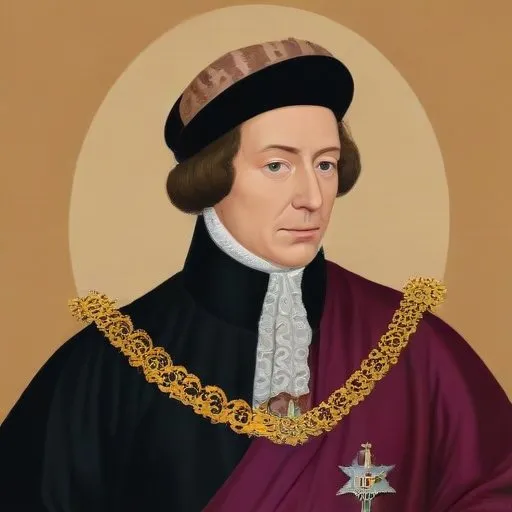
Henry Wriothesley, 3rd Earl of Southampton: The Fair Youth of Shakespeare's Sonnets
A Patron of the Arts and a Turbulent Life
Henry Wriothesley, 3rd Earl of Southampton, is famously known as the dedicatee of
William Shakespeare's two narrative poems,
Venus and Adonis and
The Rape of Lucrece. He is also frequently identified as the "Fair Youth" of Shakespeare's Sonnets, a distinction that has sealed his place in literary history.
Early Life and Inheritance
Born on October 6, 1573, at Cowdray House, Sussex, Henry Wriothesley was the only son of
Henry Wriothesley, 2nd Earl of Southampton, and Mary Browne. When his father died in 1581, the eight-year-old Henry inherited the earldom and a substantial landed income valued at £1,097 6s per annum. His wardship and marriage were sold by Queen Elizabeth I to her kinsman, Charles, Lord Howard of Effingham, for £1,000.
Education and Early Influences
In 1585, at the age of twelve, Southampton entered St John's College, Cambridge, where he graduated with a Master of Arts degree in 1589. During this period, he came under the influence of William Cecil, Lord Burghley, who played a significant role in shaping his life and career.
A Life of Turmoil and Adventure
Southampton's life was marked by turmoil and adventure. He was known for his fiery temperament, which often landed him in trouble. In 1598, he was involved in a duel with Edward Vere, 17th Earl of Oxford, which led to his imprisonment in the Fleet Prison. He was later released and joined the Earl of Essex's rebellion against Queen Elizabeth I, for which he was imprisoned again in 1601.
Patronage and Cultural Impact
Despite his turbulent life, Southampton was a patron of the arts, and his association with Shakespeare has had a lasting impact on literature. He was also a supporter of the Navy and played a key role in the development of the English naval fleet.
Personal Life and Legacy
Southampton married Elizabeth Vernon in 1598, with whom he had a daughter, Penelope. He died on November 10, 1624, leaving behind a legacy that continues to fascinate historians and literature enthusiasts alike.
Trivia and Fun Facts
- Southampton's mother, Mary Browne, married three times after the death of his father.
- He was known for his athleticism and was an accomplished horseman.
- Southampton's marriage to Elizabeth Vernon was considered scandalous, as she was a lady-in-waiting to Queen Elizabeth I.
A Lasting Impact on Literature
Henry Wriothesley, 3rd Earl of Southampton, may have lived a tumultuous life, but his association with Shakespeare has ensured his place in the annals of literary history. As the "Fair Youth" of Shakespeare's Sonnets, he remains an enigmatic figure, whose life continues to captivate and inspire us to this day.
FAQ
What was Henry Wriothesleys role in English politics?
Henry Wriothesley, 3rd Earl of Southampton, was an English politician and nobleman who played a significant role in English politics during the late 16th and early 17th centuries. He served as Lord Lieutenant of Hampshire and was a member of the House of Lords.
What was Henry Wriothesleys relationship with William Shakespeare?
Henry Wriothesley is believed to have been the patron of William Shakespeare, and may have been the dedicatee of Shakespeares sonnets. Wriothesleys influence and support likely played a significant role in Shakespeares early career.
What were Henry Wriothesleys military achievements?
Henry Wriothesley was a skilled military leader who fought in several battles, including the Siege of Cadiz and the Battle of the Isle of Wight. He was praised for his bravery and strategic thinking, and was rewarded with several honors and titles.
How did Henry Wriothesleys family influence English history?
Henry Wriothesleys family, the Earls of Southampton, played a significant role in English history. They were influential in shaping English politics, culture, and society, and produced several notable figures, including politicians, military leaders, and writers.
What is Henry Wriothesleys legacy in English history?
Henry Wriothesleys legacy in English history is one of military and political achievement, as well as cultural patronage. He is remembered as a key figure in the Elizabethan and Jacobean eras, and his influence can still be seen in English literature, politics, and culture today.