


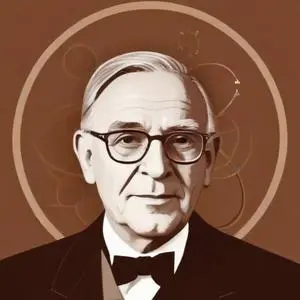
Developed groundbreaking methods for synthesizing and using boranes, a class of compounds crucial in organic chemistry, earning the Nobel Prize in Chemistry in 1979.
Herbert Charles Brown, a renowned American chemist, is best known for his groundbreaking work on organoboranes, which earned him the prestigious Nobel Prize in Chemistry in 1979, alongside Georg Wittig. Brown's pioneering research on these complex compounds opened doors to new avenues in organic chemistry, revolutionizing the field of chemical synthesis.
Born on May 22, 1912, in London to Ukrainian Jewish immigrants, Brown's family moved to Chicago when he was just two years old. He attended Crane Junior College, where he met his future wife, Sarah Baylen, and later transferred to Wright Junior College due to the former's threat of closure. Brown completed his undergraduate degree in 1936 from the University of Chicago, after which he became a naturalized United States citizen.
Unable to find an industrial position, Brown began his academic career as a postdoctoral researcher. He joined the University of Chicago as an instructor in 1939 and remained there for four years before moving to Wayne University in Detroit as an assistant professor. In 1947, he became a professor of inorganic chemistry at Purdue University, a position he held until his death in 2004. During his tenure, he was promoted to Professor Emeritus in 1978.
Brown's most significant contribution lies in the development of organoboranes, which are compounds containing boron bonded to carbon. His work on these compounds led to the discovery of new reaction mechanisms and the creation of novel organic compounds. This research paved the way for significant advances in fields such as pharmaceuticals, agriculture, and materials science.
In addition to his Nobel Prize, Brown received numerous awards and honors for his contributions to chemistry. These include the American Chemical Society's Award in Inorganic Chemistry, the National Medal of Science, and the Priestley Medal.
Brown's marriage to Sarah Baylen lasted over 67 years, and he credited her with sparking his interest in hydrides of boron, which ultimately led to his Nobel Prize-winning work. The Herbert C. Brown Laboratory of Chemistry at Purdue University was named in his honor, a testament to his enduring impact on the scientific community.
Brown's legacy extends beyond his scientific contributions. He was known for his passion for teaching and mentoring, and his dedication to promoting chemistry education. He will be remembered as a pioneer, a educator, and a true champion of scientific inquiry.
Herbert C. Brown's remarkable journey, from his humble beginnings as a Ukrainian immigrant to his rise as a Nobel laureate, serves as a beacon of inspiration for aspiring scientists and researchers. His groundbreaking work on organoboranes continues to shape the field of chemistry, ensuring his legacy as one of the most influential chemists of the 20th century.
98 Years Old
Developed innovative synthetic methods, transforming organic chemistry and enabling the creation of complex molecules with precise structures.
84 Years Old
Developed groundbreaking catalysts that enabled efficient and environmentally friendly production of complex molecules, revolutionizing the field of organic chemistry.
81 Years Old
Developed a catalyst that enables the efficient and environmentally friendly production of pharmaceuticals, fuels, and other valuable chemicals, earning a Nobel Prize in Chemistry in 2005.
95 Years Old
A French chemist and academic who developed the metathesis reaction, a method for rearranging molecules, and was awarded the Nobel Prize in Chemistry in 2005.
88 Years Old
A Japanese chemist and Nobel laureate who developed innovative methods for synthesizing organic compounds, particularly chirally active molecules, revolutionizing pharmaceutical and agrochemical industries.
