


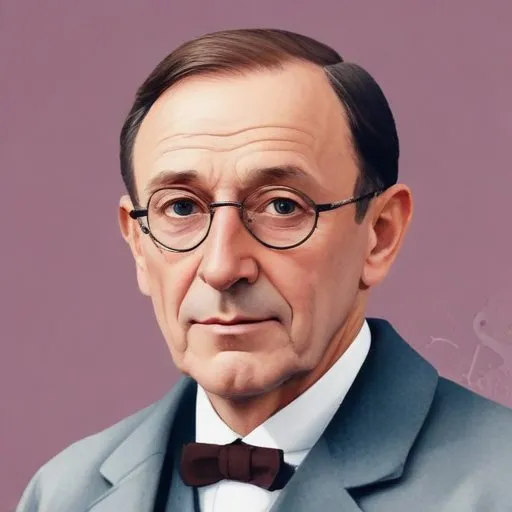
A French chemist and academic who developed the metathesis reaction, a method for rearranging molecules, and was awarded the Nobel Prize in Chemistry in 2005.
Yves Chauvin, the French chemist, is renowned for deciphering the intricate process of olefin metathesis, a groundbreaking discovery that earned him the 2005 Nobel Prize in Chemistry, along with Robert H. Grubbs and Richard R. Schrock.
This pioneering work, which began in the early 1970s, has had a profound impact on the field of organic chemistry, enabling the creation of novel materials, pharmaceuticals, and other compounds.
Yves Chauvin was born on October 10, 1930, in Menen, Belgium, to French parents. His father, an electrical engineer, instilled in him a passion for science from an early age.
Chauvin graduated from the Ecole Supérieure de Chimie Physique Électronique de Lyon in 1954, marking the beginning of his illustrious career in chemistry.
In 1960, Chauvin joined the French Petroleum Institute in Rueil-Malmaison, where he began to explore the mysteries of metathesis. His work at the institute led to numerous breakthroughs, cementing his reputation as a leading expert in the field.
After retiring from the institute in 1995, Chauvin became an honorary director of research, continuing to contribute to the advancement of chemistry.
In addition to the Nobel Prize in Chemistry, Chauvin was elected a member of the French Academy of Sciences in 2005. He received the prestigious award from the King of Sweden and delivered a memorable Nobel lecture.
Chauvin's approach to science was guided by a willingness to take risks and explore the unknown. He once said, "If you want to find something new, look for something new... there is a certain amount of risk in this attitude, but you are so happy when you succeed that it is worth taking the risk."
Through his work, Chauvin has inspired generations of chemists, fostering a culture of innovation and discovery.
Yves Chauvin's groundbreaking work in metathesis has left an indelible mark on the field of chemistry, with far-reaching implications for the development of new materials, medicines, and technologies.
His legacy continues to inspire scientists and researchers, pushing the boundaries of human knowledge and innovation.
84 Years Old
Developed groundbreaking catalysts that enabled efficient and environmentally friendly production of complex molecules, revolutionizing the field of organic chemistry.
81 Years Old
Developed a catalyst that enables the efficient and environmentally friendly production of pharmaceuticals, fuels, and other valuable chemicals, earning a Nobel Prize in Chemistry in 2005.
85 Years Old
Developed innovative methods for molecule-building and pioneered "click chemistry," earning a Nobel Prize in Chemistry. His work has far-reaching implications for fields like medicine and materials science.
Born in 1912
Developed groundbreaking methods for synthesizing and using boranes, a class of compounds crucial in organic chemistry, earning the Nobel Prize in Chemistry in 1979.
Born in 1897
Developed the Wittig reaction, a groundbreaking method for forming carbon-carbon double bonds, revolutionizing organic chemistry. This discovery enabled the creation of complex molecules with unprecedented precision.
Born in 1902
A German chemist and academic who discovered the Diels-Alder reaction, a fundamental process in organic chemistry, and was awarded the Nobel Prize in Chemistry in 1950.
