


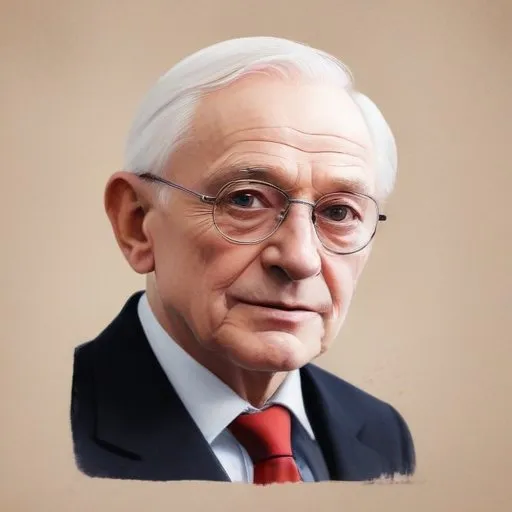
A German chemist and academic who discovered the Diels-Alder reaction, a fundamental process in organic chemistry, and was awarded the Nobel Prize in Chemistry in 1950.
Kurt Alder was a German chemist and Nobel laureate renowned for his groundbreaking work on the Diels-Alder reaction, a fundamental process in organic chemistry that enables the synthesis of complex molecules. This pioneering discovery, made in collaboration with his teacher Otto Paul Hermann Diels, earned him the 1950 Nobel Prize in Chemistry.
Born on July 10, 1902, in Königshütte, Silesia (now Chorzów, Poland), Alder received his early schooling in the industrial area. After Königshütte became part of Poland in 1922, Alder left the area and pursued higher education in Germany.
He studied chemistry at the University of Berlin from 1922 and later at the University of Kiel, where he was awarded his PhD in 1926 under the supervision of Otto Paul Hermann Diels.
Alder's academic career was marked by several significant appointments, including his role as reader for chemistry at Kiel in 1930 and lecturer in 1934. In 1936, he joined I G Farben Industrie at Leverkusen, where he worked on synthetic rubber.
In 1940, he became Professor of Experimental Chemistry and Chemical Technology at the University of Cologne and Director of the Institute of Chemistry, a position he held until his death in 1958.
Throughout his career, Alder published over 151 papers on the synthesis of organic compounds, showcasing his dedication to original research despite the challenges faced in Europe during that time.
The Diels-Alder reaction, discovered by Alder and Diels, is a concerted cycloaddition reaction between a diene and an alkene, resulting in the formation of a cyclohexene derivative. This reaction has had a profound impact on the field of organic chemistry, enabling the synthesis of complex molecules with ease.
The reaction's significance is underscored by its numerous applications in the production of pharmaceuticals, agrochemicals, and materials science.
Alder received several honorary degrees and awards for his contributions to chemistry, including the prestigious 1950 Nobel Prize in Chemistry, which he shared with Diels.
The lunar crater Alder is named in his honor, a testament to his lasting legacy in the scientific community.
Alder's personal life remains somewhat shrouded in mystery, with his death on June 20, 1958, aged 55, being somewhat unexpected. The cause of his death remains unknown.
Despite the untimely end to his life, Alder's groundbreaking work continues to inspire generations of chemists and scientists, cementing his place as one of the most influential figures in the history of organic chemistry.
Alder's remarkable journey, marked by innovative discoveries and perseverance, serves as a testament to the power of human ingenuity and the importance of pursuing one's passion.
Born in 1876
A German chemist and academic who discovered and developed the Diels-Alder reaction, a fundamental process in organic chemistry, earning him a Nobel Prize in 1950.
Born in 1903
A German biochemist and academic who discovered the sex hormones estrogen and testosterone, and was awarded the Nobel Prize in Chemistry in 1939.
Born in 1887
A Croatian-Swiss biochemist and academic who discovered the sex hormones and was awarded the Nobel Prize in Chemistry in 1939 for his work on polymethylenes and higher terpenes. His research laid the foundation for the development of new medicines and insecticides.
Born in 1906
A Croatian-Swiss chemist and academic who pioneered research in organic chemistry, particularly in the field of stereochemistry, and was awarded the Nobel Prize in Chemistry in 1975.
Born in 1881
Developed groundbreaking theories on polymers, revolutionizing the field of organic chemistry, and was awarded the Nobel Prize in Chemistry in 1953.
Born in 1860
A pioneer in biochemistry, he discovered that yeast extracts can ferment sugar without living yeast cells, laying the foundation for modern industrial fermentation processes. His work revolutionized the production of beer, wine, and bread.
Born in 1868
Developed a process to synthesize ammonia, revolutionizing agriculture and warfare, and was awarded the Nobel Prize in Chemistry in 1918.
Born in 1874
Developed the Haber-Bosch process, a method to produce ammonia on an industrial scale, revolutionizing fertilizer production and agriculture. This innovation had a profound impact on global food supply and population growth.
