


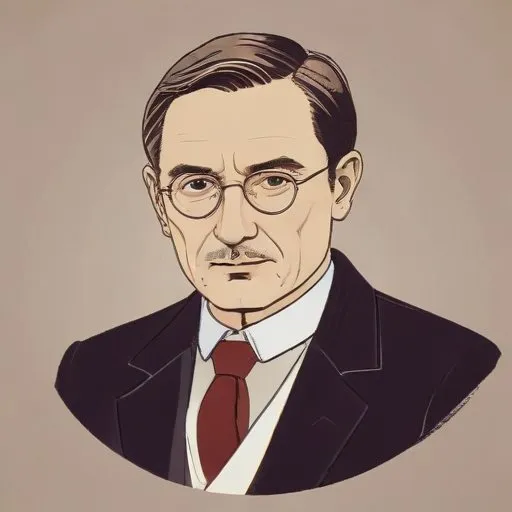
A Croatian-Swiss chemist and academic who pioneered research in organic chemistry, particularly in the field of stereochemistry, and was awarded the Nobel Prize in Chemistry in 1975.
Vladimir Prelog, a Croatian-Swiss organic chemist, revolutionized the field of chemistry with his groundbreaking research on the stereochemistry of organic molecules and reactions, earning him the 1975 Nobel Prize in Chemistry. His work paved the way for a deeper understanding of the three-dimensional structure of molecules, a crucial aspect of modern chemistry.
Prelog was born on July 23, 1906, in Sarajevo, Bosnia and Herzegovina, then part of Austria-Hungary, to Croat parents Milan and Franciska Prelog. His father, a history professor, instilled in him a love for learning, which would shape his future. As an 8-year-old boy, Prelog witnessed the assassination of Archduke Franz Ferdinand, an event that would change the course of world history.
Prelog's early education took him from Sarajevo to Zagreb, where he completed his elementary school education. He then moved to Osijek, where his interest in chemistry began to take shape under the guidance of his professor, Ivan Kuria. At just 16, Prelog published his first scientific paper in the German journal Chemiker Zeitung, demonstrating his analytical instrument used in chemical labs.
In 1924, Prelog completed his high school education in Zagreb and moved to Prague, where he earned his diploma in chemical engineering from the Czech Technical University in 1928. Under the mentorship of Emil Votoek and Rudolf Luke, Prelog developed a deep understanding of organic chemistry. He received his Sc.D. in 1929 and began working in the plant laboratory of G.J. Drza in Prague, despite the limited academic opportunities available during the Great Depression.
Prelog's research focused on the stereochemistry of organic molecules and reactions, leading to significant breakthroughs in the field. He elucidated the concept of molecular asymmetry, demonstrating that a molecule's three-dimensional structure could influence its chemical properties. This discovery has far-reaching implications for the development of pharmaceuticals, agrochemicals, and other fields.
Vladimir Prelog's work has had a profound impact on the field of chemistry, influencing generations of scientists and researchers. His research has paved the way for the development of new pharmaceuticals, agrochemicals, and other products. Prelog's legacy extends beyond his scientific contributions, inspiring future generations to pursue careers in chemistry and related fields.
Throughout his life, Prelog was driven by a passion for discovery and a commitment to advancing human knowledge. His groundbreaking research, awards, and honors serve as a testament to his enduring legacy in the world of chemistry.
Vladimir Prelog's remarkable journey, marked by groundbreaking research, numerous awards, and a lasting impact on the field of chemistry, serves as an inspiration to scientists and researchers around the world.
Born in 1906
A Swiss chemist who discovered LSD, a potent psychoactive substance, and pioneered its research, leading to significant advancements in psychopharmacology. His work has had a profound impact on our understanding of the human mind.
Born in 1897
A Polish-Swiss chemist and academic who discovered vitamin C and developed a method for its industrial production, earning a Nobel Prize in Physiology or Medicine in 1937.
Born in 1887
A Croatian-Swiss biochemist and academic who discovered the sex hormones and was awarded the Nobel Prize in Chemistry in 1939 for his work on polymethylenes and higher terpenes. His research laid the foundation for the development of new medicines and insecticides.
Born in 1881
Organic chemist and Nobel laureate who synthesized hemin and chlorophyll, leading to a deeper understanding of biological pigments. His work has far-reaching implications for fields like medicine and agriculture.
Born in 1872
A German-Swiss chemist and academic who discovered the structure of chlorophyll, the green pigment in plants, and was awarded the Nobel Prize in Chemistry in 1915. His work laid the foundation for modern plant biochemistry.
Born in 1835
German chemist and Nobel laureate who synthesized barbituric acid and developed the theory of organic dyes, revolutionizing the textile industry. His work laid the foundation for modern dye chemistry.
Born in 1868
Developed a process to synthesize ammonia, revolutionizing agriculture and warfare, and was awarded the Nobel Prize in Chemistry in 1918.
Born in 1874
Developed the Haber-Bosch process, a method to produce ammonia on an industrial scale, revolutionizing fertilizer production and agriculture. This innovation had a profound impact on global food supply and population growth.
