


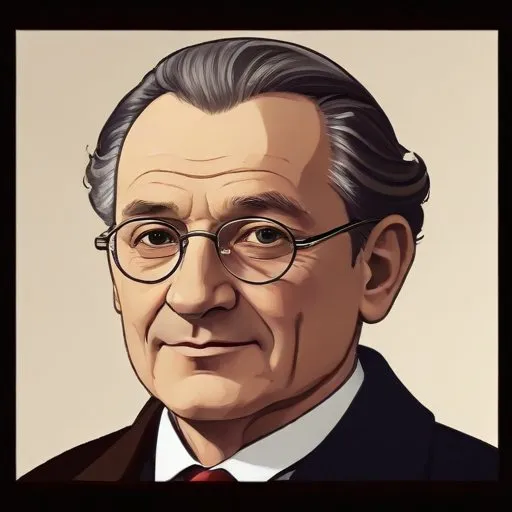
A Polish-Swiss chemist and academic who discovered vitamin C and developed a method for its industrial production, earning a Nobel Prize in Physiology or Medicine in 1937.
Tadeusz Reichstein, a Polish-Swiss chemist, etched his name in the annals of history by making a groundbreaking discovery that revolutionized the field of medicine. In 1950, he was awarded the Nobel Prize in Physiology or Medicine for his pioneering work on the isolation of cortisone, a crucial hormone produced by the adrenal cortex.
Reichstein was born on July 20, 1897, in Wocławek, Russian Empire (now Poland), to a Polish-Jewish family. His parents, Gastawa Brockmann and Izydor Reichstein, sought refuge in Switzerland in 1907, fleeing the violent pogroms that swept across the Russian Empire. Reichstein began his education at a boarding school in Jena, Germany, before moving to Zurich, Switzerland, at the age of 10.
Reichstein's academic journey took him to the Technical University of Karlsruhe, where he studied under the esteemed chemist Hermann Staudinger. It was during this period that he met Leopold Ruzicka, a fellow doctoral student who would later become a close collaborator. In 1933, Reichstein succeeded in synthesizing vitamin C (ascorbic acid) through a process that would later bear his name – the Reichstein process.
In 1937, Reichstein was appointed Associate Professor at ETHZ, and later moved to the University of Basel, where he became Professor of Pharmaceutical Chemistry and, subsequently, Professor of Organic Chemistry. His work on hormones of the adrenal cortex, culminating in the isolation of cortisone, earned him the Nobel Prize in Physiology or Medicine in 1950, jointly awarded with Edward Calvin Kendall and Philip Showalter Hench.
In the latter part of his life, Reichstein's focus shifted to the phytochemistry and cytology of ferns. He published over 80 papers on these subjects, leaving an indelible mark on the field. His insatiable curiosity and dedication to scientific inquiry characterize his remarkable career, which spanned over six decades.
Tadeusz Reichstein's work has had a profound impact on modern medicine, paving the way for the development of life-saving treatments and medications. His groundbreaking discovery of cortisone has improved the lives of countless individuals, and his contributions to phytochemistry continue to inspire new generations of scientists.
Reichstein's legacy extends beyond the realm of science, serving as a testament to the power of human ingenuity, perseverance, and dedication. He remained an active and engaged member of the scientific community until his passing on August 1, 1996, leaving behind a rich and enduring legacy that continues to inspire and motivate scientists, researchers, and scholars worldwide.
Born in 1906
A Swiss chemist who discovered LSD, a potent psychoactive substance, and pioneered its research, leading to significant advancements in psychopharmacology. His work has had a profound impact on our understanding of the human mind.
Born in 1906
A Croatian-Swiss chemist and academic who pioneered research in organic chemistry, particularly in the field of stereochemistry, and was awarded the Nobel Prize in Chemistry in 1975.
Born in 1918
Organic chemist and Nobel laureate who developed a new way to synthesize complex molecules, revolutionizing the field of chemistry. His work led to the creation of new medicines and materials.
Born in 1897
A Norwegian chemist and academic who pioneered the study of molecular structure, particularly the three-dimensional shape of molecules, and was awarded the Nobel Prize in Chemistry in 1969.
Born in 1912
A renowned chemist and academic who discovered and isolated ten transuranic elements, including plutonium, and was a leading figure in the development of nuclear energy. His work had a profound impact on our understanding of the periodic table and the properties of atomic nuclei.
Born in 1897
Developed the Wittig reaction, a groundbreaking method for forming carbon-carbon double bonds, revolutionizing organic chemistry. This discovery enabled the creation of complex molecules with unprecedented precision.
98 Years Old
Developed innovative synthetic methods, transforming organic chemistry and enabling the creation of complex molecules with precise structures.
