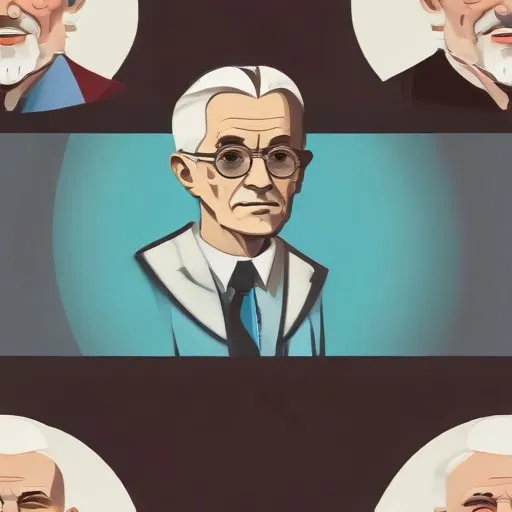
Odd Hassel

Odd Hassel

Odd Hassel was born on May 17th, 1897

Full Name: Odd Hassel
Place of Birth: Kristiania, Norway
Profession: Chemist and Academic
Notable Work: Electron Density
Date of Birth: May 17, 1897
Date of Death: May 11, 1981
Nationality: Norwegian
Nobel Prize: 1969 Chemistry

A Norwegian chemist and academic who pioneered the study of molecular structure, particularly the three-dimensional shape of molecules, and was awarded the Nobel Prize in Chemistry in 1969.

Timeline
1901
Born in Kristiania
Odd Hassel was born on May 17th, 1901, in Kristiania (now Oslo), Norway.
1924
Earned Ph.D. in Chemistry
Hassel earned his Ph.D. in chemistry from the University of Oslo in 1924.
1935
Became Professor of Chemistry
Hassel became a professor of chemistry at the University of Oslo in 1935, a position he held until 1964.
1969
Awarded Nobel Prize in Chemistry
Hassel was awarded the Nobel Prize in Chemistry in 1969 for his work on the structure of molecules.
1981
Died at 81
Odd Hassel passed away on May 11th, 1981, at the age of 81, in Oslo, Norway.
Odd Hassel

Odd Hassel Quiz

What field of study did Odd Hassel primarily contribute to?

Score: 0/5
FAQ
What was Odd Hassels Nobel Prize winning discovery?
Odd Hassel was awarded the Nobel Prize in Chemistry in 1969 for his discovery of the electron diffraction method, which is used to study molecular structure.
What was Odd Hassels academic career like?
Odd Hassel held various academic positions, including Professor of Chemistry at the University of Oslo.
What were Odd Hassels contributions to chemistry?
Odd Hassel made significant contributions to the field of chemistry, including the development of the concept of molecular structure and the discovery of the electron diffraction method.
What awards did Odd Hassel receive?
Odd Hassel received numerous awards for his contributions to chemistry, including the Nobel Prize, the Order of St. Olav, and the Honorary Medal of the Norwegian Chemical Society.
What is Odd Hassels legacy?
Odd Hassel is remembered as a pioneering chemist who made significant contributions to our understanding of molecular structure and chemistry.

Related People:

Linus Pauling

Born in 1901

Pioneering chemist and peace activist who won two unshared Nobel Prizes, one for chemistry and one for peace, for his groundbreaking work on the nature of the chemical bond and his tireless efforts to promote nuclear disarmament.

Robert S. Mulliken

Born in 1896

Developed the molecular orbital method, a fundamental concept in chemistry that explains the structure and behavior of molecules. He was awarded the Nobel Prize in Chemistry in 1966 for his work.

Eugene Wigner

Born in 1902

A Hungarian physicist and mathematician who made groundbreaking contributions to quantum mechanics and nuclear physics, and was awarded the Nobel Prize in Physics in 1963.

Derek Barton

Born in 1918

Organic chemist and Nobel laureate who developed a new way to synthesize complex molecules, revolutionizing the field of chemistry. His work led to the creation of new medicines and materials.

Glenn T. Seaborg

Born in 1912

A renowned chemist and academic who discovered and isolated ten transuranic elements, including plutonium, and was a leading figure in the development of nuclear energy. His work had a profound impact on our understanding of the periodic table and the properties of atomic nuclei.

Ragnar Frisch

Born in 1895

Developed econometrics, a statistical approach to economic analysis, and founded the discipline of econophysics, earning the first Nobel Prize in Economics in 1969.

Harold Urey

Born in 1893

A pioneering scientist who discovered deuterium, a heavy isotope of hydrogen, and later contributed to the discovery of many other elements, revolutionizing our understanding of the universe.