


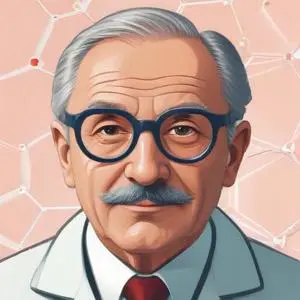
A Russian-Swiss chemist and academic who discovered vitamins and investigated their role in human health, earning a Nobel Prize in Chemistry in 1937.
Paul Karrer, a Swiss organic chemist, is renowned for his groundbreaking research on vitamins, which earned him the Nobel Prize in Chemistry in 1937 alongside Norman Haworth. His work revolutionized the understanding of these essential nutrients, paving the way for significant advancements in the field of nutrition and medicine.
Born on April 21, 1889, in Moscow, Russia, to Swiss parents Paul Karrer and Julie Lerch, Karrer returned to Switzerland with his family in 1892. He received his education at Wildegg and the Old Cantonal School Aarau, where he matriculated in 1908. Karrer's academic pursuits took him to the University of Zurich, where he studied chemistry under the guidance of Alfred Werner, earning his Ph.D. in 1911.
Karrer's initial research focus was on complex metal compounds, but his attention soon shifted to plant pigments, particularly the yellow carotenoids. This marked the beginning of his most significant contributions to the field of chemistry. His work on carotenoids led to the elucidation of their chemical structure and the discovery that some of these substances are transformed in the body into vitamin A.
Karrer's research resulted in the establishment of the correct constitutional formula for beta-carotene, the chief precursor of vitamin A. This achievement marked the first time that the structure of a vitamin or provitamin had been established. This monumental discovery paved the way for a deeper understanding of the role of vitamins in human health and nutrition.
Karrer's work on vitamins continued with the confirmation of the structure of ascorbic acid (vitamin C) and his research on vitamins B2 and E. His investigations into the chemistry of flavins led to the identification of lactoflavin as part of the complex originally thought to be vitamin B2.
Karrer's contributions to the field of chemistry earned him numerous honors and awards, including the Nobel Prize in 1937. His textbook, Lehrbuch der Organischen Chemie (Textbook of Organic Chemistry), published in 1927, went through thirteen editions and was translated into seven languages.
Paul Karrer's work has had a profound impact on our understanding of vitamins and their role in human health. His research has influenced generations of scientists and has paved the way for significant advancements in the fields of nutrition, medicine, and biochemistry. Karrer's legacy serves as a testament to the power of dedication, hard work, and innovative thinking in the pursuit of scientific discovery.
In addition to his groundbreaking research, Karrer was also an accomplished teacher and mentor. George Wald, who later won the Nobel Prize in Physiology or Medicine, worked briefly in Karrer's laboratory while studying the role of vitamin A in the retina.
Karrer held various academic positions throughout his career, including Professor of Chemistry and Director of the Chemical Institute at the University of Zurich. He was known for his dedication to teaching and mentoring, inspiring numerous students and researchers who went on to make significant contributions to the field of chemistry.
Paul Karrer's remarkable journey, marked by his groundbreaking research and dedication to teaching and mentoring, has left an indelible mark on the field of chemistry and beyond.
Born in 1854
A German physician and biologist who discovered the first effective treatment for syphilis and developed the concept of chemotherapy, earning a Nobel Prize in Physiology or Medicine in 1908.
Born in 1835
German chemist and Nobel laureate who synthesized barbituric acid and developed the theory of organic dyes, revolutionizing the textile industry. His work laid the foundation for modern dye chemistry.
Born in 1852
A German chemist and academic who won the Nobel Prize for synthesizing amino acids and sugars, and establishing the structure of purines, revolutionizing the field of organic chemistry.
Born in 1898
Developed groundbreaking catalysts that revolutionized the production of plastics and led to the creation of new materials, earning a Nobel Prize in Chemistry.
Born in 1868
Developed a process to synthesize ammonia, revolutionizing agriculture and warfare, and was awarded the Nobel Prize in Chemistry in 1918.
Born in 1906
A German-Irish biochemist and academic who discovered penicillin's antibacterial properties and developed it as a therapeutic agent, revolutionizing the treatment of bacterial infections.
